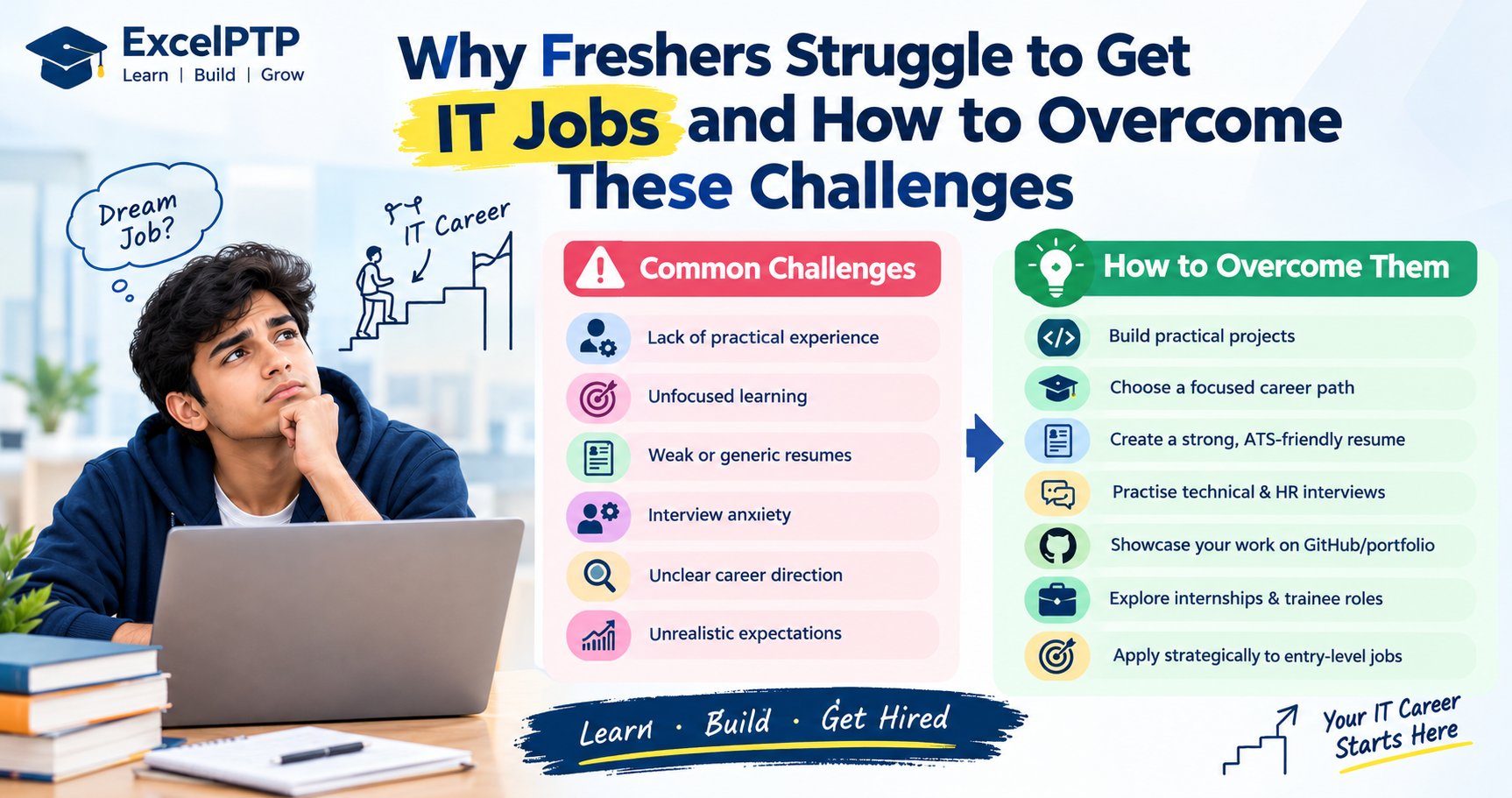
Starting an IT career can feel confusing for fresh graduates. You may have a degree, completed a course, and learned programming basics, yet your applications receive no response or you struggle to clear technical interviews. Understanding why freshers struggle to get IT jobs is the first step toward improving your chances.
In India, entry-level IT jobs often expect more than academic knowledge. Employers want people who can apply technical concepts, solve problems, communicate clearly, and learn on the job. The good news is that freshers can work on these areas with a structured plan.
This guide explains the common challenges faced by IT freshers, practical ways to overcome them, and how to prepare for IT jobs for freshers in India, including Ahmedabad's IT job market.
Quick Answer: Why Do Freshers Struggle to Get IT Jobs?
Freshers often struggle to get IT jobs because they lack practical project experience, have limited IT interview preparation, submit generic resumes, or apply without a clear career direction. To improve their chances, they should choose a suitable IT career path, practise relevant technical skills for freshers, build demonstrable projects, create a targeted fresher resume for IT jobs, gain practical experience, and prepare consistently for interviews.
Search Intent and Content Gaps
Search intent: Informational and solution-oriented. Readers want to understand why fresh graduates struggle to get IT jobs and what they can do to become job-ready.
Content gaps this article addresses:
- It explains the difference between completing a course and demonstrating job-ready IT skills.
- It connects common hiring challenges with specific actions rather than offering generic motivation.
- It gives examples of practical IT projects for beginners across different entry-level roles.
- It provides a structured 30-day IT job preparation plan for candidates who do not know where to begin.
- It covers technical and non-technical barriers, including communication, applications, and interview confidence.
1. Lack of Practical Skills and Real-World Experience
One of the main reasons freshers struggle to get IT jobs is the gap between knowing a concept and using it to solve a real problem.
A graduate may understand Python syntax, HTML tags, SQL queries, or Java fundamentals but still find it difficult to build a working application independently. Employers need evidence that candidates can use their knowledge, debug errors, and explain their decisions.
How to Overcome This Challenge
Focus on applying your skills instead of collecting course completion certificates.
- For web development: Build a responsive website with forms, validation, and database integration.
- For Python development: Create a task manager, file-processing script, or simple API-based application.
- For data analytics: Analyse a sales dataset using Excel, SQL, Python, or Power BI and explain the business insights.
- For software testing: Prepare test cases, report defects, and practise basic API testing.
- For cloud and DevOps: Deploy a basic website and document the deployment process, including any errors you resolved.
Start with small projects and improve them gradually. A completed project that you understand is more valuable than a copied project you cannot explain.
How Many Projects Should a Fresher Build?
Aim for two or three relevant IT projects for freshers that demonstrate different aspects of your chosen role. Quality matters more than quantity. Each project should have a clear purpose, understandable code or documentation, and a working demonstration where practical.
2. Trying to Learn Too Many Technologies at Once
Another common problem is learning everything that appears in job descriptions. A fresher may begin Python, switch to Java, start React, explore machine learning, and then move to cloud computing without becoming confident in any one area.
This creates scattered knowledge and makes IT job preparation for freshers difficult.
How to Overcome This Challenge
Choose one primary IT career path for beginners based on your interests, current skills, and the types of entry-level jobs available to you.
| Career path | Skills to prioritise | Beginner project |
|---|---|---|
| Web developer | HTML, CSS, JavaScript, a framework, APIs | Responsive portfolio or booking app |
| Python developer | Python, SQL, APIs, debugging | Task management application |
| Data analyst | Excel, SQL, statistics, Power BI or Python | Sales performance dashboard |
| QA tester | Testing fundamentals, test cases, bug reporting, API basics | Test plan for a sample website |
| Java developer | Java, OOP, SQL, collections | Student management system |
| Cloud/DevOps trainee | Linux, Git, networking, Docker, cloud basics | Deploy a containerised website |
These are starting points, not rigid requirements. Check current job descriptions for the role you want and prioritise the skills employers repeatedly request.
For more structured learning options, explore ExcelPTP's professional training programs.
3. Having a Weak or Generic Fresher Resume
A resume is often the first opportunity to demonstrate your suitability for a role. If it contains only a degree, a list of technologies, and a few vague statements, recruiters may find it difficult to understand what you can actually do.
For example, writing “Knowledge of Python and SQL” provides limited evidence of practical ability. Describing a project that uses Python and SQL to analyse data gives a recruiter something concrete to evaluate.
How to Improve Your Fresher Resume for IT Jobs
Include these essential sections:
- Contact details: Name, professional email, phone number, and relevant portfolio or GitHub links.
- Career summary: Two or three lines describing your target role and strongest relevant skills.
- Technical skills for freshers: List technologies you can genuinely use and explain.
- Projects: Mention the problem, technologies used, your contribution, and the result.
- Education: Include your qualification, institution, and graduation year.
- Internships or practical training: Add relevant experience and specific responsibilities.
- Certifications: Include relevant certifications without allowing them to overshadow practical work.
Example of a Stronger Project Description
Instead of:
“Made a sales dashboard using Power BI.”
Write:
“Created a Power BI sales dashboard using a sample sales dataset, added interactive filters, and visualised revenue trends by product and region.”
Only include features you actually implemented. Never invent project results, professional experience, or technical skills.
Practical tip: Maintain a master resume, then adjust the summary, skills, and project order for each relevant job application. Keep the layout simple, use clear headings, and avoid unnecessary graphics that can interfere with applicant tracking systems (ATS).
4. Not Having a Clear Portfolio or GitHub Profile
A candidate may know how to code but have no easy way to demonstrate it. This makes it harder for recruiters or interviewers to distinguish practical ability from theoretical knowledge.
A portfolio does not need to be elaborate. Its purpose is to help someone quickly understand what you have built and what you contributed.
How to Overcome This Challenge
Create a simple portfolio or GitHub profile that includes:
- Two or three relevant projects.
- A clear README explaining each project's purpose.
- Setup instructions and technologies used.
- Screenshots or a live demo when appropriate.
- Your actual contribution, including any challenges you solved.
For data analytics, include the dataset source where permitted, cleaning steps, queries, dashboards, and key findings. For web development, provide screenshots, the source code, and a live demonstration where possible.
If you use AI coding tools, understand and test the code they generate. Interviewers may ask why you chose a particular approach, how the application works, or how you would fix a bug. You should be able to answer those questions yourself.
5. Poor Technical Interview Preparation
Knowing a technology and explaining it in an interview are different skills. Freshers sometimes spend weeks watching tutorials but rarely practise solving problems without assistance.
They may struggle with basic programming questions, SQL queries, object-oriented programming, project explanations, or follow-up questions.
How to Overcome This Challenge
Prepare for the requirements of your chosen role.
For developer roles:
- Practise programming fundamentals, data structures, and problem-solving at the level required by target jobs.
- Revise functions, loops, arrays, strings, and error handling.
- Prepare basic SQL and object-oriented programming questions where relevant.
- Practise explaining your code aloud.
For data analyst roles:
- Practise Excel formulas, data cleaning, SQL joins, aggregation, and dashboard interpretation.
- Revise basic statistics and explain how your analysis supports a business decision.
- Prepare to discuss the assumptions and limitations of your project.
For QA roles:
- Revise testing concepts, test case design, defect life cycles, and severity versus priority.
- Practise identifying edge cases and writing clear bug reports.
- Learn relevant API or automation basics where required by the vacancy.
Use a Simple Interview Practice Routine
Spend 30–60 minutes a day on IT interview preparation for freshers, technical questions, project explanations, and mock interviews. After every practice session, write down the questions you could not answer and revise them later.
Do not memorise every answer word for word. Focus on understanding the concept and communicating your reasoning.
6. Weak Communication and Difficulty Explaining Projects
IT work involves more than writing code. Developers discuss requirements, analysts present findings, testers report defects, and support professionals help users understand technical issues.
A fresher does not need perfect English to succeed. However, being unable to explain a solution clearly can make it difficult for an interviewer to assess their knowledge.
How to Overcome This Challenge
Practise answering common interview questions in simple, professional language.
For example, prepare a clear answer to “Tell me about your project” using this structure:
- Problem: What did you want to solve?
- Approach: What tools and technologies did you use?
- Contribution: What did you personally build?
- Challenge: What went wrong, and how did you fix it?
- Outcome: What does the finished project do, and what did you learn?
Record yourself explaining a project for two minutes. Listen for unclear explanations, unnecessary details, and technical terms you cannot define.
Practise speaking in English if your target roles require it, but prioritise clarity, accuracy, and confidence over using complicated vocabulary.
7. Applying for Jobs Without a Targeted Strategy
Sending the same resume to dozens of unrelated vacancies may feel productive, but it can lead to low response rates. A candidate applying simultaneously for frontend development, data science, cybersecurity, and technical support may struggle to present a consistent career direction.
Some vacancies also require experience, technologies, or qualifications the candidate does not have.
How to Overcome This Challenge
Use a focused IT job search strategy for freshers.
- Identify one primary role and, if appropriate, one closely related alternative.
- Read job descriptions and note recurring skills.
- Apply when you meet the core requirements, even if you do not satisfy every optional preference.
- Tailor your resume to relevant responsibilities and technologies.
- Track applications, responses, interview dates, and follow-up actions.
- Use professional networking, alumni contacts, company career pages, and reputable job portals.
Look for titles such as Graduate Trainee, Junior Developer, Associate Software Engineer, QA Trainee, Data Analyst Intern, and Technical Support Engineer, depending on your preparation. Titles and eligibility vary by employer.
In Ahmedabad, candidates can also investigate local IT companies, software service providers, startups, internships, and campus or training-based hiring opportunities. Verify each vacancy's requirements and legitimacy before applying.
8. Ignoring Internships and Practical Training Opportunities
Some freshers apply only for permanent jobs and overlook internships because they believe internships are useful only for students who are still studying.
In reality, a relevant internship or supervised project can help a recent graduate gain practical exposure, understand team workflows, and build examples for future interviews. However, internships differ in quality, and not every internship leads to a permanent job.
How to Overcome This Challenge
Consider IT internships for freshers and trainee roles that provide meaningful experience.
Before accepting an opportunity, check:
- Whether the responsibilities are clearly explained.
- Whether you will work on relevant tasks or projects.
- Whether mentorship and feedback are available.
- Whether the schedule, duration, compensation, and other terms are transparent.
- Whether the organisation has a credible presence and verifiable work.
Practical IT training can also help you build skills when you need structure and guidance. ExcelPTP provides professional training programs and information about its placement support. Review the specific program details and placement terms to understand what is included; no training course can guarantee a job.
9. Depending Too Much on Certificates or AI Tools
Certificates can demonstrate that you completed a learning program, but they do not automatically prove that you can perform a job. Similarly, using AI tools to generate code or interview answers without understanding them can leave gaps in your knowledge.
How to Overcome This Challenge
Treat certificates as supporting evidence, not a replacement for practical work.
For every course you complete, aim to produce something demonstrable: a project, a technical report, a dashboard, a test plan, or a deployed application.
Use AI tools responsibly to:
- Clarify difficult concepts.
- Generate practice questions.
- Review code and investigate errors.
- Explore alternative solutions.
- Improve documentation.
Verify important outputs, test the code, and learn the underlying concepts. Follow employer rules about AI use during assessments and interviews.
Your goal is not simply to finish more courses. It is to demonstrate that you can apply what you have learned.
10. Giving Up After Repeated Rejections
Job searching can be discouraging, especially when candidates receive few responses or repeatedly fail technical rounds. But rejection alone does not tell you exactly what went wrong.
The useful response is to identify patterns and adjust your preparation.
How to Overcome This Challenge
Review your job-search progress every week.
- Few interview calls: Revisit your resume, role selection, skills match, and application quality.
- Resume shortlisted but technical round failed: Strengthen fundamentals and practise relevant technical questions.
- Technical round passed but communication round failed: Practise explaining your reasoning and project decisions.
- Repeated project-related questions expose gaps: Improve your project understanding and documentation.
- Applications are not relevant to your skills: Refine your target roles and read eligibility criteria carefully.
You may not receive feedback from every employer. Use the evidence available to improve rather than assuming every rejection has the same cause.
11. A Practical 30-Day Plan to Become More Job-Ready
If you are unsure where to begin, use this 30-day IT job preparation plan for freshers. Adjust the schedule according to your current skill level and available time.
Days 1–7: Choose Your Role and Assess Your Skills
Select a target job, review relevant vacancies, identify skill gaps, and revise the fundamentals required for that role.
Days 8–14: Build or Improve a Practical Project
Work on a relevant project, test it, document it, and prepare to explain your technical decisions.
Days 15–21: Prepare Your Resume and Interview Skills
Update your resume, organise your GitHub or portfolio, practise technical questions, and conduct mock interviews.
Days 22–30: Apply, Practise, and Improve
Apply to suitable vacancies, explore internships, practise interviews, and review your progress at the end of each week.
Thirty days is a starting point, not a promise of employment. Candidates starting from scratch may need longer to develop the required skills.
12. Common Mistakes Freshers Should Avoid
Avoid these mistakes while preparing for your first IT job:
- Learning multiple technologies without mastering the fundamentals of one career path.
- Copying projects without understanding how they work.
- Listing skills on a resume that you cannot demonstrate.
- Applying only to famous companies while ignoring suitable smaller employers.
- Ignoring internships and trainee opportunities that offer relevant experience.
- Memorising interview answers without practising problem-solving.
- Sending the same resume for every vacancy.
- Paying recruiters who promise guaranteed jobs without verifiable terms.
- Treating rejection as proof that you cannot succeed in IT.
Instead, focus on steady improvement, practical work, relevant applications, and honest communication.
How Can ExcelPTP Help Freshers Prepare for IT Jobs?
For candidates who need guidance choosing a technology or building practical skills, structured training can provide a clearer starting point.
ExcelPTP, based in Ahmedabad, offers IT training programs designed around different technology areas. Depending on your goals, you can explore the following resources:
- Professional Training Programs — explore available courses and identify a suitable learning path.
- Placement Support — review the placement-related support and services offered.
- Student Testimonials — read learner experiences to help you evaluate the training provider.
Before enrolling, ask about the syllabus, hands-on projects, trainer support, course duration, interview preparation, and the exact terms of any placement assistance.
The right learning path depends on your background, current abilities, and target role. A course is most useful when you actively practise, complete projects, and prepare to demonstrate your skills.
Conclusion
Understanding why freshers struggle to get IT jobs helps turn a frustrating job search into a practical improvement plan. The biggest challenges often involve limited hands-on experience, unfocused learning, weak resumes, and insufficient interview practice.
You do not need to learn every technology before applying. Start with one suitable career path, strengthen its fundamentals, build projects you can explain, and apply for relevant entry-level IT jobs. Review your progress regularly and use each interview as a chance to identify what to improve.
For freshers in Ahmedabad and across India, consistent preparation and practical evidence of your abilities can help you compete more effectively for IT jobs for freshers in India.