
A Software Tester Career is one of the most promising paths for beginners entering the IT industry. Software testing offers excellent growth opportunities, competitive salaries, and a clear learning path. If you are interested in quality assurance and problem-solving, a software tester career can help you build a successful future in technology..
Quality Assurance has become an essential part of modern software development. Whether it is a startup, mid-sized company, or multinational organization, every software product requires testing before it reaches customers. Therefore, the demand for QA professionals continues to grow every year.
This article provides a complete roadmap for building a successful career in Quality Assurance. Before selecting any career path, it is important to consider market demand, salary potential, and personal interest.
Today, there are countless career opportunities available in the IT industry. However, choosing the right path can be challenging. Fortunately, software testing offers excellent growth opportunities for both technical and non-technical professionals.
1. Market Demand: The demand for Quality Assurance professionals has increased significantly over the years. As software applications become more complex, organizations require skilled testers to ensure product quality. Consequently, software testing remains one of the most stable career options in the IT industry.
2. Salary Structure: QA professionals receive competitive salaries similar to developers in many organizations. Furthermore, acquiring automation testing skills can significantly increase earning potential.
3. Interest Level: Software testing is an exciting profession that involves problem-solving, critical thinking, and continuous learning. Moreover, it offers opportunities to work with the latest technologies.
Not only technical professionals but also non-technical individuals can build a successful career in Quality Assurance.
Quality Assurance is the process of ensuring that software products meet specified requirements and quality standards. In simple terms, QA professionals verify that an application works correctly and delivers a positive user experience.
Human beings naturally make mistakes. Therefore, software developed by humans may also contain defects. Since developers can sometimes overlook their own mistakes, independent testing becomes essential. As a result, organizations rely on QA professionals to identify issues before software reaches customers.

Software failures can damage a company's reputation and customer trust. Therefore, thorough testing helps organizations deliver reliable and high-quality products. In addition, quality software improves customer satisfaction and strengthens brand value.
Both technical and non-technical candidates can begin their careers as Junior QA Testers. After gaining 2–3 years of experience, they can advance to Senior QA Engineer roles. Subsequently, professionals can move into Team Lead positions and eventually become QA Managers with sufficient industry experience.
1) Analytical and Logical Thinking:
A successful software tester must possess strong analytical and logical thinking abilities. Furthermore, testers should not only identify defects but also reproduce them and perform root cause analysis when necessary.
2) Intellectual Curiosity and Creativity:
QA professionals should be naturally curious and willing to ask questions. Moreover, creativity helps testers discover hidden defects and improve testing processes.
3) Passion for Testing:
Passion for quality is one of the most important characteristics of a software tester. Consequently, passionate testers develop a "test-to-break" mindset that helps uncover critical defects before release.
4) Think from the Customer's Point of View:
Testers should always evaluate software from the user's perspective. In addition, understanding customer expectations helps ensure that the final product meets business requirements.
5) Domain Knowledge:
Domain knowledge helps testers understand business processes and user expectations. As a result, they can identify defects that may affect real-world usage.
6) Technical Skills:
Technical knowledge is an added advantage for testers. Furthermore, familiarity with programming concepts, databases, and automation tools such as Selenium and QTP can significantly improve career opportunities.
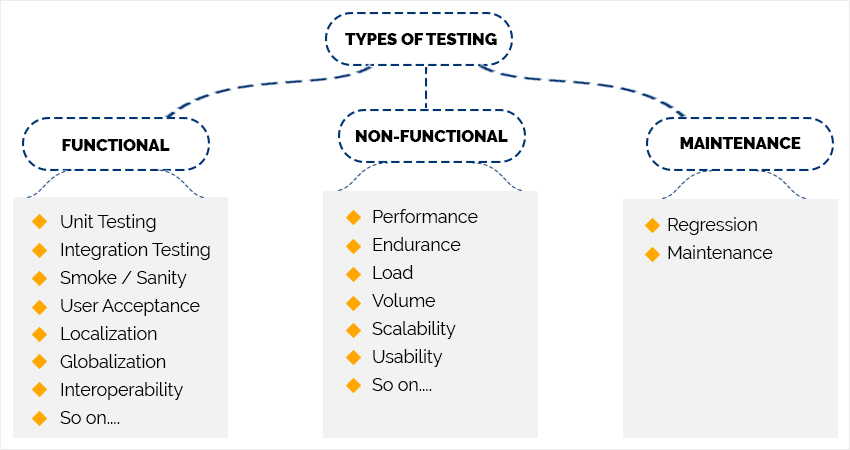
Software testing can be classified into Functional Testing and Non-Functional Testing. Both categories play an important role in delivering high-quality software products.
A) Black Box Testing:
Black Box Testing evaluates software functionality without examining internal code structures. Therefore, testers focus on inputs, outputs, and expected behavior.
B) White Box Testing:
White Box Testing focuses on internal code structure, logic, and implementation. Consequently, it is often performed by developers or testers with programming knowledge.
Non-Functional Testing:
Non-Functional Testing evaluates performance, scalability, security, usability, and compatibility. For example, Performance Testing measures how many users can access the system simultaneously.
Maintenance Testing:
Once software is deployed, updates and modifications are introduced regularly. Therefore, Maintenance Testing ensures that these changes do not negatively affect existing functionality.

Dedicated customized live learning at your own schedule.

Focus in a way that will help you clear the base concept.

No prior experience is required, you will be trained from scratch.

Approximately It will take about 1-3 months for you to learn.

Earn an experience work certificate upon completion.

Anyone you like to go with English, Hindi, Gujarati etc.