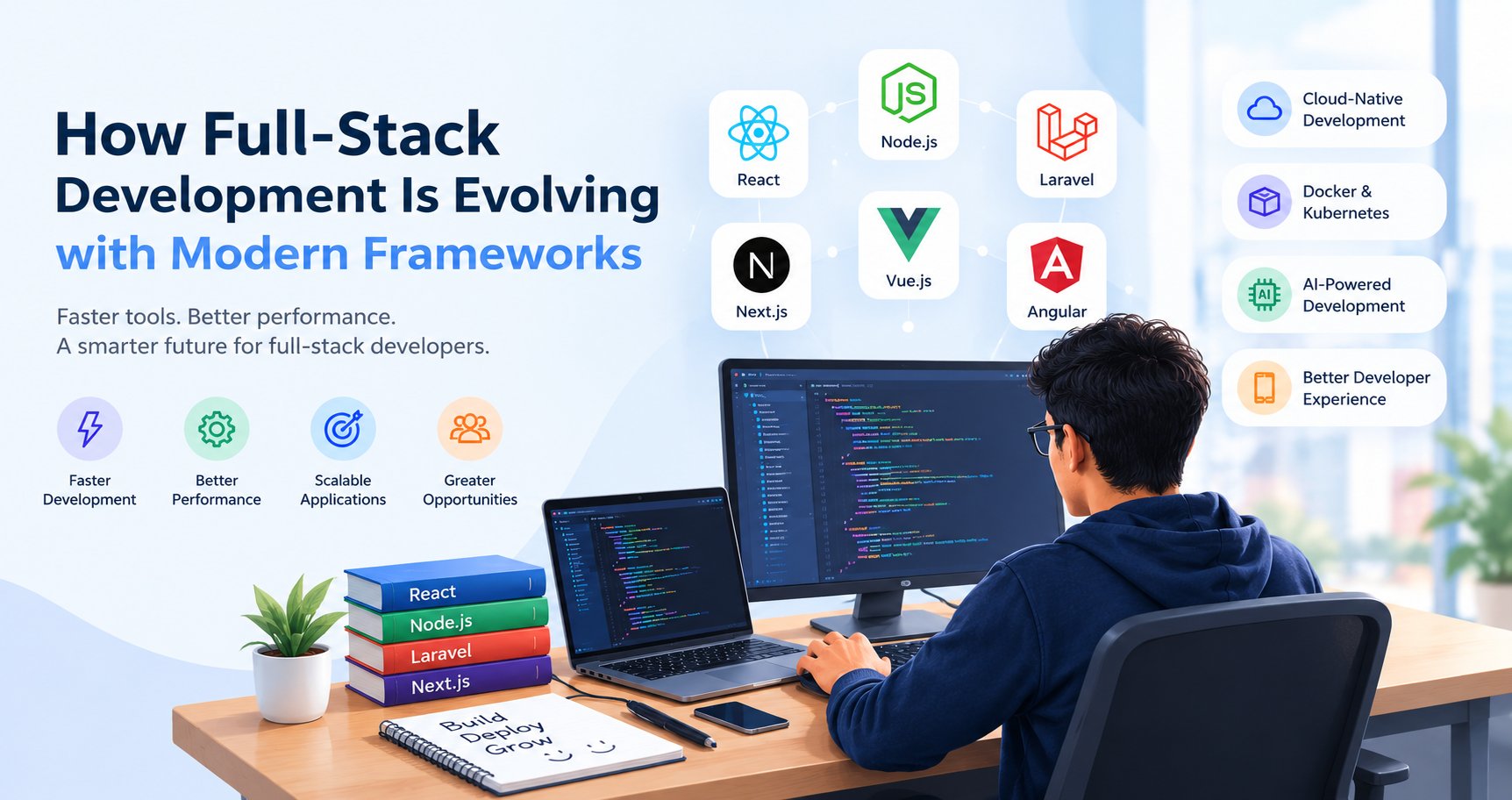
Full-stack development is changing as businesses look for web applications that are faster, more secure, easier to maintain, and ready to scale. Modern frameworks such as React, Next.js, Angular, Vue.js, Django, and Node.js are helping developers build complete applications with better development workflows and improved performance.
For students, freshers, and working professionals, understanding how full-stack development is evolving with modern frameworks can help them choose the right skills and prepare for real-world projects. Instead of learning every new tool, developers should focus on programming fundamentals, frontend and backend development, databases, APIs, security, testing, and deployment.
In this guide, we will explore the latest full-stack development trends, popular frameworks, the role of AI tools, essential skills, practical projects, and a learning roadmap for aspiring developers in India.
Quick Answer: How Is Full-Stack Development Evolving?
Full-stack development is moving towards integrated frameworks, reusable UI components, server-side rendering, TypeScript, API-driven architectures, cloud deployment, and AI-assisted coding. Modern tools such as Next.js, React, Angular, Vue.js, Django, and Node.js help developers build and maintain applications more efficiently. However, choosing the right technology depends on project requirements, performance needs, team skills, and long-term maintenance.
1. Why Is Full-Stack Development Changing?
Traditional web development often required developers to manage separate tools for frontend interfaces, backend logic, database operations, routing, and deployment. Modern frameworks increasingly provide integrated solutions that simplify these tasks.
Businesses also expect applications to deliver more than basic functionality. A modern web application may need responsive interfaces, secure authentication, real-time updates, reliable APIs, and support for mobile users.
Several factors are driving this change:
- Faster development: Reusable components and framework conventions reduce repetitive work.
- Better performance: Server-side rendering, caching, and optimized asset delivery can improve user experience.
- Scalability: Modern application architectures help teams manage growing traffic and functionality.
- Improved developer experience: TypeScript, testing tools, and integrated development workflows help identify problems earlier.
- AI-assisted coding: Developers can use AI tools to explore solutions, generate initial code, and understand unfamiliar codebases.
- Greater security expectations: Authentication, authorization, validation, and dependency management are essential parts of application development.
The goal is not simply to write code faster. It is to build applications that work reliably and remain maintainable as requirements change.
2. Modern Full-Stack Frameworks Developers Should Understand
A framework provides conventions, libraries, and tools that help developers build applications. Different frameworks solve different problems, so there is no single best option for every project.
React and Next.js
React is a JavaScript library used to build interactive user interfaces. Developers create reusable components and manage how the interface responds to user actions.
Next.js builds on React and provides additional capabilities for full-stack web applications, including routing, server rendering, and server-side functionality. Its App Router supports features such as Server Components and Server Functions.
Where they are useful:
- E-commerce platforms
- Business dashboards
- Content-driven websites
- SaaS applications
- Interactive portals
What to learn: JavaScript, React components, hooks, routing, data fetching, TypeScript, and Next.js fundamentals.
Official references: React documentation and Next.js documentation.
Angular
Angular is a comprehensive framework for building web applications. It includes established patterns for components, dependency injection, routing, forms, and application organization.
Angular can be a suitable choice for large business applications where teams need consistent architecture and structured development practices.
Where it is useful:
- Enterprise applications
- Administrative portals
- Complex forms and dashboards
- Large applications maintained by multiple developers
What to learn: TypeScript, components, services, dependency injection, routing, forms, and testing.
Vue.js and Nuxt
Vue.js is a progressive JavaScript framework for building user interfaces. Its component-based approach can make it approachable for beginners while supporting complex applications.
Nuxt extends Vue with application-level features, including routing and server-rendering options.
Where they are useful:
- Content websites
- Interactive business applications
- E-commerce interfaces
- Applications built by teams already using Vue
Django and Node.js
Full-stack development is not limited to JavaScript frameworks.
Django is a Python web framework that includes tools for routing, database models, forms, authentication, and administrative interfaces. It is useful for data-driven applications and can integrate with Python-based automation or AI services.
Node.js allows JavaScript to run on the server. Developers commonly use it with Express or NestJS to build APIs and backend services.
Choose according to your goals:
- Learn React and Next.js if you want to focus on modern React-based applications.
- Learn Angular if your target projects use its structured ecosystem.
- Learn Vue.js and Nuxt if you prefer the Vue ecosystem.
- Learn Python and Django if you enjoy Python and want to build data-driven web applications.
- Learn Node.js with Express or NestJS if you want to build JavaScript or TypeScript backends.
You can compare framework usage in the Stack Overflow Developer Survey.
3. The Shift Towards Integrated Full-Stack Frameworks
One important change is that developers can now handle more application responsibilities within a single framework or closely connected ecosystem.
For example, a Next.js application can combine frontend components, routing, server-side operations, and data access patterns. A Django application can combine backend logic, database models, templates, and administrative tools.
This does not mean every application should use one framework for everything. Separate frontend and backend systems remain useful when teams need independent scaling, separate deployment cycles, or multiple clients consuming the same API.
What does this mean for developers?
You should understand how different application layers communicate, even when a framework hides some of the implementation details.
A typical application includes:
- Frontend: Displays pages, forms, navigation, and interactive components.
- Backend: Handles business rules, authentication, permissions, and processing.
- Database: Stores users, products, transactions, and other application data.
- API layer: Exchanges data between the frontend, backend, and external services.
- Deployment environment: Runs the application and supports monitoring, updates, and scaling.
Knowing these layers helps you troubleshoot problems instead of relying entirely on framework defaults.
4. Server-Side Rendering and Better Web Performance
Modern frameworks offer several rendering approaches, including client-side rendering, server-side rendering, and static site generation. Some also support hybrid strategies, allowing different pages to use different approaches.
Client-side rendering
The browser loads JavaScript and uses it to render much of the interface.
This approach works well for many interactive applications, although the initial experience depends on factors such as JavaScript size, device performance, and network conditions.
Server-side rendering
The server generates HTML for a request and sends it to the browser. This can improve the initial page experience in appropriate situations, especially when the application needs request-specific content.
Static site generation
Pages are generated ahead of time and served as static files. This can be effective for documentation, marketing pages, and content that does not change on every request.
Which approach should you choose?
Do not select rendering methods just because they are trending. Consider:
- How frequently the content changes
- Whether the page needs personalized information
- Search engine visibility requirements
- Server and hosting costs
- Caching opportunities
- User experience and performance measurements
A developer should understand why a rendering strategy is appropriate, not just how to configure it.
5. TypeScript Is Becoming an Important Skill
JavaScript remains fundamental to web development, but TypeScript adds static typing that can help developers identify certain errors during development.
For example, consider a function that calculates a product's total price:
function calculateTotal(price: number, quantity: number): number {
    return price * quantity;
}

console.log(calculateTotal(500, 3));
The parameter types make the function's expectations clearer. TypeScript cannot prevent every runtime error, but it can improve code clarity and help catch many type-related mistakes before execution.
Why should beginners learn TypeScript?
- It supports clearer contracts between components and functions.
- It can make large codebases easier to maintain.
- It improves editor assistance and refactoring.
- It is useful in many React, Angular, and Node.js projects.
Start with JavaScript fundamentals first. Then learn TypeScript types, interfaces, function types, generics, and how to type API responses.
6. AI Tools Are Changing the Developer Workflow
AI coding assistants can help developers generate code examples, explain errors, create test cases, and understand unfamiliar libraries. They can also speed up repetitive tasks.
However, AI-generated code may contain incorrect assumptions, security weaknesses, outdated APIs, or inefficient solutions.
How should full-stack developers use AI?
Use AI tools to:
- Generate a starting point for a component or API endpoint.
- Explain an unfamiliar error message.
- Suggest test cases for an existing function.
- Draft documentation.
- Compare alternative implementation approaches.
- Review code for possible issues before manual verification.
Always review generated code, run tests, verify library documentation, and check security-sensitive logic yourself.
For example, if an AI assistant generates a login API, you must still verify password hashing, input validation, authentication, authorization, error handling, and protection against common attacks.
The valuable skill is not merely writing prompts. It is understanding enough software development to evaluate the output.
7. APIs, Databases, and Authentication Remain Essential
Modern frameworks simplify development, but they do not remove the need to understand backend fundamentals.
API development
APIs allow different parts of an application to communicate. REST APIs remain widely used, while GraphQL can be useful when clients need more flexible data queries.
Developers should understand HTTP methods, status codes, JSON, request validation, error handling, and API testing.
Database management
Relational databases such as MySQL and PostgreSQL are useful for structured data and relationships. MongoDB is a document database that suits certain document-oriented data models.
Learn how to design tables or collections, use indexes appropriately, maintain data integrity, and write efficient queries.
Authentication and authorization
Authentication confirms who a user is. Authorization determines what that user can access.
For example, an online training portal may allow students to view their own course material while administrators manage users and course records.
A secure implementation should consider password hashing, session or token management, access control, input validation, and safe handling of secrets.
8. Cloud Deployment and DevOps Are Part of Modern Full-Stack Work
Building an application locally is only one part of the development process. A project must also be configured, tested, deployed, monitored, and updated.
Modern teams use services and tools for application hosting, database management, continuous integration, automated testing, and monitoring.
Skills worth learning
- Git and GitHub
- Environment variables and configuration
- Basic Linux commands
- Docker fundamentals
- CI/CD concepts
- Cloud hosting basics
- Application logs and error monitoring
- Backup and recovery practices
Beginners do not need to master every cloud platform immediately. Start by deploying one working application and understanding how its frontend, backend, and database are connected.
9. Security and Testing Must Be Built In
A functional application is not necessarily a reliable application. Security and testing should be considered throughout development rather than added at the last minute.
Essential security practices
- Validate inputs on the server.
- Use parameterized database queries or safe ORM methods.
- Protect private routes and sensitive operations.
- Keep credentials out of source code.
- Update vulnerable dependencies.
- Use HTTPS in production.
- Avoid exposing personal or confidential data in logs.
Testing practices
Developers should understand unit testing, integration testing, API testing, and end-to-end testing.
For example, an e-commerce application should test whether a product can be added to the cart, whether the correct total is calculated, and whether an unauthorized user can access a protected order.
Testing becomes particularly important when a project has multiple components or when framework upgrades introduce unexpected changes.
10. Full-Stack Skills for Freshers in India
Students and freshers do not need to learn every framework to become employable. A focused skill set and demonstrable projects are usually a more practical starting point than collecting certificates across unrelated technologies.
| Skill area | What to learn |
|---|---|
| Web fundamentals | HTML, CSS, JavaScript, responsive design |
| Frontend | React, Angular, or Vue.js |
| Backend | Django, Node.js, Express, or another suitable framework |
| Database | MySQL or PostgreSQL; learn MongoDB when relevant |
| APIs | REST, HTTP, JSON, validation, error handling |
| Development tools | Git, GitHub, browser developer tools |
| Testing | Unit tests, API tests, basic end-to-end testing |
| Deployment | Hosting, environment configuration, basic cloud concepts |
| Professional skills | Debugging, communication, documentation, teamwork |
The best combination depends on the jobs you are targeting. Review current job descriptions in Ahmedabad and other Indian technology hubs to identify recurring requirements before finalizing your learning plan.
11. Practical Full-Stack Projects to Build
Projects help demonstrate that you can connect frontend screens, backend logic, databases, and deployment.
Project 1: Student Management System
Build a system to add, update, view, and delete student records.
Features to include:
- Student registration form
- Data validation
- Search and filtering
- Database integration
- Admin login
- Responsive interface
Suggested stack: React with Node.js and PostgreSQL, or Django with templates and a relational database.
Project 2: Job Portal for Freshers
Create a portal where job seekers can view openings and employers can manage listings.
Features to include:
- User registration and login
- Job listing and search
- Application submission
- Role-based access
- Application status tracking
- Admin dashboard
This project demonstrates database relationships, authentication, API design, and business logic.
Project 3: E-commerce Application
Build a small online store with product pages and a shopping cart.
Features to include:
- Product catalogue
- Category filtering
- Cart management
- Order history
- Admin product management
- Secure payment integration using a test environment, if included
Do not store payment card details yourself. Use a suitable payment provider and follow its integration and security guidance.
Project 4: AI-Powered FAQ Assistant
Build a website that answers questions from a controlled set of documents or FAQs.
Features to include:
- Searchable knowledge base
- Backend API
- Basic conversation interface
- Source references for answers
- Error handling
- Feedback collection
This project can introduce AI integration without replacing the core full-stack skills required to build a reliable application.
For each project, include a README file, screenshots, setup instructions, sample data, and a live demo where practical. Be prepared to explain your technical decisions during an interview.
12. A 90-Day Full-Stack Development Learning Roadmap
Here is a practical starting plan for a learner who can study consistently. Adjust the pace according to your current experience and daily availability.
Days 1–30: Build the foundations
Focus on HTML, CSS, JavaScript, responsive design, Git, and basic programming concepts.
Practice tasks:
- Create a personal portfolio.
- Build a responsive landing page.
- Validate a form using JavaScript.
- Practise arrays, objects, functions, and asynchronous JavaScript.
Days 31–60: Learn one frontend and backend stack
Choose one main combination rather than switching frameworks every few days.
For example, learn React with Node.js and Express, or Python with Django. If you choose React, add Next.js after understanding the core React concepts.
Practice tasks:
- Build reusable components or templates.
- Create CRUD operations.
- Connect a relational database.
- Build and test API endpoints.
- Add login and role-based access.
Days 61–90: Complete and deploy a project
Choose a project that solves a clear problem and finish its main features.
Practice tasks:
- Add input validation and error handling.
- Write essential tests.
- Use Git consistently.
- Deploy the application.
- Document the setup and architecture.
- Practise explaining your project and solving coding questions.
At the end of 90 days, aim to have a working project and a clear understanding of its architecture. The roadmap is a guide, not a guarantee of job readiness; prior knowledge and practice time make a difference.
13. Common Mistakes to Avoid
Learning too many frameworks at once: Master one stack before exploring alternatives.
Copying projects without understanding them: Be able to explain every major component and how data flows through the application.
Ignoring database fundamentals: A polished interface cannot compensate for incorrect data modelling or unreliable queries.
Skipping security and testing: Include validation, access control, and meaningful tests from the beginning.
Depending entirely on AI-generated code: Verify outputs and understand the code you submit or deploy.
Building projects without deployment: A deployed project helps demonstrate that you can move beyond local development.
Ignoring job descriptions: Learn technologies that align with your target roles instead of chasing every new release.
14. Career Opportunities in Full-Stack Development
A strong foundation in full-stack development can prepare learners for roles such as:
- Junior Full-Stack Developer
- Frontend Developer
- Backend Developer
- React Developer
- Python-Django Developer
- Node.js Developer
- Web Application Developer
The actual requirements vary by employer and project. Some positions focus heavily on frontend interfaces, while others emphasize APIs, databases, cloud infrastructure, or enterprise systems.
Freshers should focus on programming fundamentals, project quality, debugging, communication, and interview preparation. Practical experience and the ability to explain technical decisions can help distinguish an applicant from someone who has only completed tutorials.
How ExcelPTP Can Support Your Learning
If you are starting your IT career or strengthening your development skills, structured practice can help you connect concepts with real application requirements.
Explore ExcelPTP professional training programs to review relevant learning options. You can also read student training experiences and contact ExcelPTP to discuss your learning goals.
Choose a program based on the skills you need, the practical work involved, and how well it fits your career plans.
Conclusion
Full-stack development is evolving through integrated frameworks, improved rendering strategies, TypeScript, AI-assisted workflows, cloud deployment, and stronger expectations for security and testing. Frameworks such as React, Next.js, Angular, Vue.js, Django, and Node.js offer different ways to build modern applications.
For aspiring developers, the most effective approach is to learn the fundamentals, choose one suitable technology stack, build practical projects, and understand how the entire application works. You do not need to master every new framework. You need to become capable of selecting appropriate tools and using them to solve real problems.