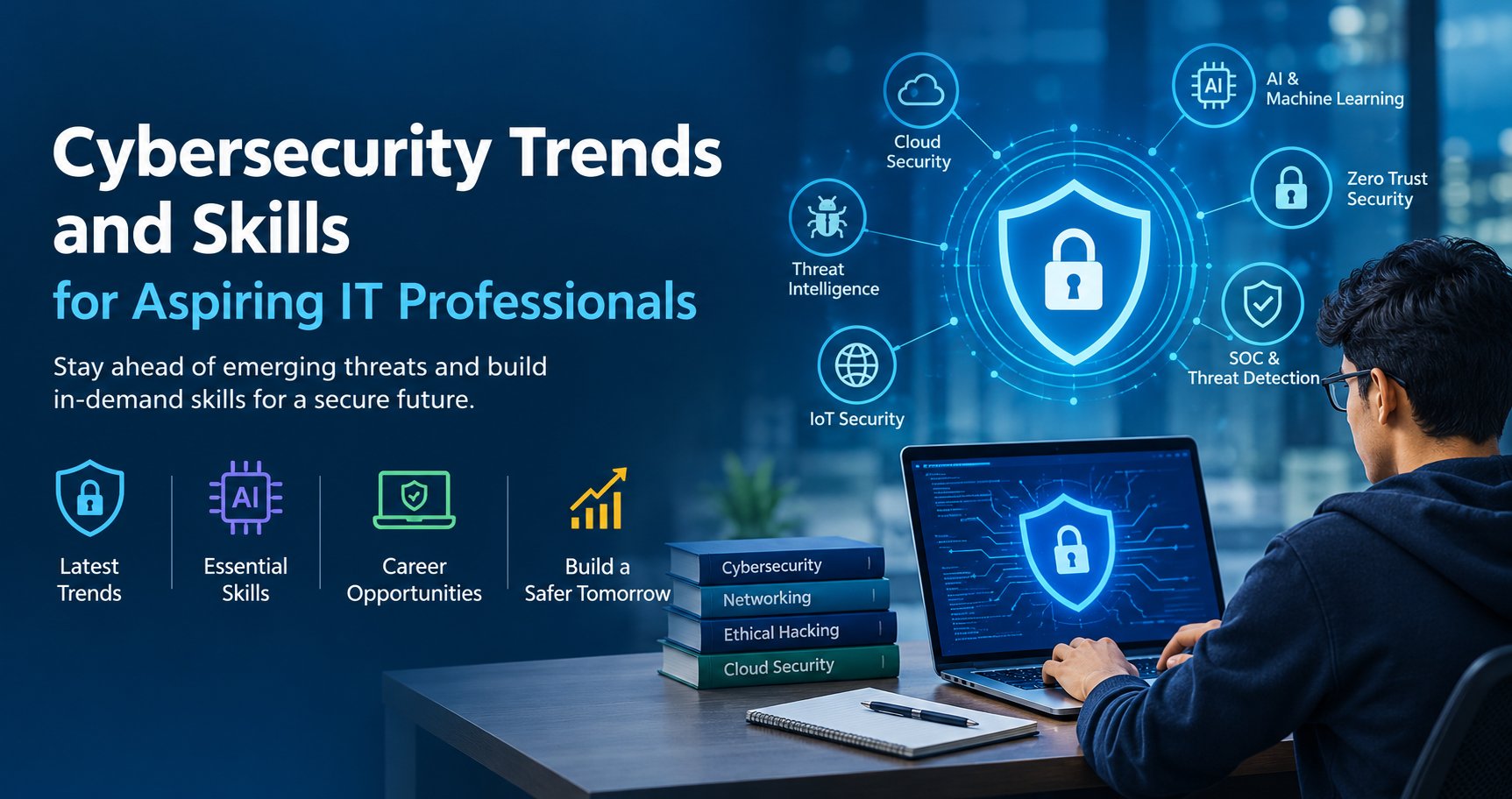
Cybersecurity has become an essential part of modern technology. Businesses use websites, cloud platforms, mobile applications, digital payments, and online databases every day. As these systems grow, protecting sensitive information and preventing cyberattacks becomes increasingly important.
For students pursuing BCA, MCA, B.Tech, computer science, or other IT-related courses, cybersecurity trends and skills offer a practical starting point for exploring careers in information security. You do not need to know everything about hacking or network security before beginning. You can start with computer networks, operating systems, security fundamentals, and hands-on projects.
In this guide, you will discover the major cybersecurity trends shaping 2026, the technical skills beginners should learn, career opportunities in India, practical project ideas, and a step-by-step roadmap to prepare for entry-level cybersecurity roles.
1. Why Is Cybersecurity Important Today?
Cybersecurity involves protecting computers, networks, applications, systems, and data from unauthorised access, damage, misuse, and disruption.
Consider an online shopping website. It stores customer information, processes payments, and connects to databases and other services. If attackers exploit a vulnerability or steal an employee's login credentials, the business could experience data exposure, financial loss, service disruption, or reputational damage.
Cybersecurity helps organisations identify these risks, reduce vulnerabilities, detect suspicious activity, and respond to incidents.
Common cybersecurity threats
- Phishing: Fraudulent emails, messages, or websites designed to trick people into revealing sensitive information.
- Ransomware: Malicious software that can encrypt or otherwise block access to data and demand payment.
- Credential theft: Stealing usernames, passwords, session tokens, or other authentication information.
- Malware: Software designed to damage systems, steal information, or perform unauthorised activities.
- Web application attacks: Exploiting weaknesses in websites, APIs, authentication, or input handling.
- Insider threats: Risks caused by malicious actions or mistakes involving people who have legitimate access.
- Cloud misconfiguration: Incorrect permissions or settings that expose data or services.
- Supply chain attacks: Compromising software, vendors, libraries, or services to reach another target.
Understanding these threats helps beginners recognise what security teams are trying to prevent and how different cybersecurity tools support that work.
2. Top Cybersecurity Trends to Know in 2026
Cybersecurity is changing as organisations adopt AI, cloud services, connected systems, and automated development tools. The following trends are particularly relevant to students planning a career in this field.
2.1 AI-powered threat detection and response
Artificial intelligence is helping security teams analyse large amounts of security data, identify unusual activity, prioritise alerts, and investigate potential incidents.
For example, a monitoring system might flag an account that suddenly logs in from an unusual location and downloads an unusually large amount of data. AI-assisted analysis can help investigators decide whether the activity requires further investigation.
Skills to learn:
- Security logs and event analysis
- Security Information and Event Management (SIEM)
- Basic Python
- Anomaly detection concepts
- Alert investigation and incident response
AI can help security teams work more efficiently, but its findings require validation. Incorrect alerts, incomplete data, and model limitations mean human judgement remains important.
2.2 AI security and AI agent protection
Generative AI and AI agents introduce new security considerations. Applications may process confidential information, connect to external tools, access business systems, or take actions on behalf of users.
Potential risks include sensitive-data exposure, prompt injection, excessive permissions, insecure AI integrations, and unauthorised access to connected tools.
For example, an AI assistant connected to an internal knowledge base should not disclose confidential documents to a user who lacks permission to access them.
Skills to learn:
- Data privacy and access control
- Secure API design
- Identity and permissions management
- Prompt injection awareness
- AI application threat modelling
- Logging and monitoring of AI workflows
AI security is an emerging specialisation, so beginners should first establish a solid foundation in application security, networking, and identity management.
2.3 Cloud security
Organisations increasingly use cloud infrastructure for hosting applications, storing files, managing databases, and running analytics workloads. These environments need appropriate access controls, secure configurations, and monitoring.
Cloud security focuses on protecting cloud resources, identities, applications, networks, and data.
Skills to learn:
- AWS, Microsoft Azure, or Google Cloud fundamentals
- Identity and Access Management (IAM)
- Cloud networking
- Encryption and secure storage
- Configuration monitoring
- Cloud logging and incident response
Start by learning one cloud platform rather than attempting to master all three at once.
2.4 Zero-trust security
Zero trust is a security approach based on verifying access requests rather than automatically trusting users or devices because they are inside a corporate network.
Access decisions can consider identity, device health, requested resources, risk, and organisational policies.
For example, an employee may need multifactor authentication and approved device access before opening a sensitive company application.
Skills to learn:
- Authentication and authorisation
- Multifactor authentication
- Identity management
- Least-privilege access
- Device security
- Access monitoring
Zero trust is not a single product. It is an approach that combines identity, access policies, monitoring, and other security controls.
2.5 Ransomware defence and cyber resilience
Ransomware remains a serious concern for organisations that depend on digital systems. Security teams need to prevent unauthorised access, detect suspicious activity, limit the spread of attacks, and recover affected systems.
Cyber resilience goes beyond preventing incidents. It also involves maintaining essential operations and recovering safely after a security event.
Skills to learn:
- Endpoint security fundamentals
- Backup and recovery planning
- Incident response
- Log analysis
- Access control
- Malware awareness
Beginners can practise by studying simulated incident logs and documenting a response plan. Never test ransomware or destructive malware on real systems.
2.6 Software supply chain and application security
Modern applications depend on open-source libraries, frameworks, third-party services, and automated build pipelines. A vulnerable dependency or compromised component can introduce security risks.
Application security focuses on identifying and reducing weaknesses during software design, development, testing, and deployment.
Skills to learn:
- HTTP and HTTPS
- Authentication and session management
- Secure coding practices
- Input validation
- Dependency scanning
- Software composition analysis
- Secure code review
Students with Python, Django, JavaScript, or web development knowledge can use these skills to explore application security and DevSecOps.
2.7 Security automation and DevSecOps
Security teams often handle repetitive tasks such as collecting logs, checking configurations, reviewing alerts, and tracking vulnerabilities. Automation can make these activities more consistent and efficient.
DevSecOps integrates security practices into software development and operations rather than treating security as a final step.
Skills to learn:
- Python or shell scripting
- Git and version control
- CI/CD fundamentals
- Automated security testing
- Vulnerability scanning
- Monitoring and reporting
A beginner project could automatically analyse a sample log file and generate a report of failed login attempts.
2.8 Identity and access management
Stolen credentials and excessive permissions can allow attackers to access systems without exploiting a traditional software vulnerability. Identity and access management helps organisations control who can access which resources and under what conditions.
Skills to learn:
- User and role management
- Password and authentication security
- Multifactor authentication
- Single sign-on concepts
- Privileged access management
- Access reviews and audit logs
Identity security is useful across cloud security, security operations, enterprise IT, and compliance roles.
2.9 Internet of Things and operational technology security
Connected devices, industrial equipment, sensors, and smart systems can introduce risks when they have weak authentication, outdated software, or poor network separation.
Operational technology security is especially important in environments where digital systems interact with physical processes.
Skills to learn:
- Network fundamentals
- Device security
- Secure configuration
- Network segmentation
- Asset inventory
- Monitoring and incident handling
Beginners can study these concepts through diagrams, virtual labs, and authorised device-testing environments.
2.10 Privacy, governance, and cyber risk management
Cybersecurity is not only about technical tools. Organisations also need to understand their risks, document policies, manage vendors, protect personal information, and meet applicable legal or regulatory obligations.
Skills to learn:
- Risk assessment
- Security policies
- Audit documentation
- Data protection principles
- Incident reporting
- Security frameworks such as NIST Cybersecurity Framework and ISO/IEC 27001
These skills can support career paths in governance, risk, and compliance (GRC), security auditing, and security management.
3. Essential Cybersecurity Skills for Beginners
You do not need to learn every security technology at the beginning. Build a foundation first, then specialise according to the type of work you enjoy.
Networking fundamentals
Understand IP addresses, DNS, ports, TCP and UDP, HTTP and HTTPS, routing, firewalls, and common network protocols.
These concepts help you understand how devices communicate and how suspicious network activity can be identified.
Linux and Windows fundamentals
Learn how operating systems manage files, users, permissions, processes, services, and logs.
Practise Linux terminal commands and become familiar with Windows security settings and event logs.
Programming and scripting
Python is useful for parsing logs, processing data, automating repetitive tasks, and building small security utilities. Basic Bash or PowerShell can also help with system administration.
You do not need advanced programming skills to start learning cybersecurity, but scripting becomes increasingly valuable as your skills develop.
Security tools
Learn what common tools do and practise only in systems you own or have explicit permission to test.
Examples include:
- Wireshark: Analyses network traffic.
- Nmap: Discovers hosts and services on authorised networks.
- Burp Suite: Supports web application security testing.
- OWASP ZAP: Helps test web application security.
- Wazuh: Provides security monitoring and detection capabilities.
- Splunk or similar SIEM platforms: Supports searching and analysing security events.
Understanding the purpose of a tool is more important than memorising commands.
Security monitoring and incident response
Learn to recognise suspicious login attempts, unexpected process activity, unusual network connections, and potential data exposure.
Practise documenting what happened, what evidence supports your findings, what actions should be taken, and what additional information is needed.
Communication and problem-solving
Cybersecurity professionals often explain technical risks to developers, managers, customers, and non-technical teams. Clear documentation, analytical thinking, attention to detail, and teamwork are essential alongside technical knowledge.
4. Cybersecurity Career Paths for Aspiring IT Professionals
Cybersecurity includes several different job families. Entry requirements vary by employer, and some roles require experience in IT support, networking, software development, or system administration.
Security Operations Centre (SOC) Analyst
SOC analysts monitor security alerts, investigate suspicious events, and help identify potential incidents.
Useful skills: Networking, SIEM, log analysis, endpoint security, incident triage, and documentation.
Beginner preparation: Practise analysing sample security logs and explaining why an event may be suspicious.
Cybersecurity Analyst
Cybersecurity analysts assess security risks, review controls, investigate threats, and help improve an organisation's security posture.
Useful skills: Security fundamentals, vulnerability management, risk analysis, monitoring, and reporting.
Penetration Tester
Penetration testers assess the security of applications, networks, and systems under an agreed scope and with explicit authorisation.
Useful skills: Networking, Linux, web technologies, vulnerability assessment, scripting, and report writing.
Important: Only test systems when you have permission. Unauthorised scanning or exploitation can cause harm and may violate applicable laws.
Cloud Security Engineer
Cloud security engineers help protect cloud infrastructure, identities, applications, and data.
Useful skills: Cloud platforms, IAM, networking, secure configuration, logging, and automation.
Application Security Engineer
Application security specialists help development teams identify and fix vulnerabilities in software and APIs.
Useful skills: Programming, secure coding, authentication, API security, dependency management, and security testing.
Incident Response Analyst
Incident response professionals investigate security incidents, contain threats, preserve evidence, and support recovery.
Useful skills: Log analysis, endpoint investigation, incident documentation, threat identification, and recovery procedures.
Governance, Risk, and Compliance (GRC) Analyst
GRC professionals help organisations assess risk, maintain policies, document controls, and prepare for audits.
Useful skills: Risk assessment, documentation, security frameworks, communication, and regulatory awareness.
Which career path should you choose?
| Your interest | Career path to explore | First skills to build |
|---|---|---|
| Monitoring and investigating alerts | SOC Analyst | Networking, logs, SIEM |
| Finding security weaknesses | Penetration Tester | Linux, web security, networking |
| Protecting cloud infrastructure | Cloud Security | Cloud fundamentals, IAM |
| Securing software | Application Security | Programming, APIs, secure coding |
| Investigating incidents | Incident Response | Logs, endpoint security, evidence handling |
| Policies and risk assessment | GRC Analyst | Risk management, frameworks, documentation |
Choose one direction for your initial learning plan. You can explore related specialisations after building a foundation.
5. Beginner-Friendly Cybersecurity Projects
Projects help you demonstrate how you apply security concepts. Use sample data, local virtual machines, intentionally vulnerable training applications, or environments that explicitly permit testing.
Project 1: Analyse failed login attempts
Use a sample authentication log and Python to identify repeated failed login attempts.
Skills practised: Python, log parsing, filtering, basic detection logic, and reporting.
Portfolio output: A script, sample input file, findings report, and explanation of the limitations of your detection rules.
Project 2: Build a basic network traffic analysis report
Capture or analyse authorised sample network traffic using Wireshark.
Skills practised: Network protocols, DNS, TCP connections, packet inspection, and evidence-based analysis.
Portfolio output: A report describing the traffic observed, relevant protocol details, and any unusual patterns.
Project 3: Create a vulnerability assessment report
Use an authorised lab or a deliberately vulnerable training environment to identify security weaknesses.
Skills practised: Asset identification, vulnerability assessment, severity classification, and remediation recommendations.
Portfolio output: A report explaining the scope, findings, risk, recommended fixes, and retest results.
Project 4: Set up a security monitoring lab
Use a local virtual machine or a permitted lab environment to collect and review system logs.
Skills practised: Log collection, event investigation, monitoring rules, and incident triage.
Portfolio output: A simple dashboard or report showing selected events and how you would investigate them.
Project 5: Review a web application for common security issues
Use an intentionally vulnerable application or your own development project. Review authentication, input validation, session handling, and access control.
Skills practised: Secure coding, web security, testing, and remediation.
Portfolio output: A list of findings, safe reproduction steps, and fixes validated in the lab.
For every project, document the objective, tools, environment, steps, findings, limitations, and recommended improvements. Never include real credentials, personal data, or confidential information in your portfolio.
6. A 90-Day Cybersecurity Learning Roadmap
A structured plan helps you build skills gradually without becoming overwhelmed by the number of security tools available.
Days 1–30: Learn the fundamentals
Focus on:
- Computer networking basics.
- Linux and Windows fundamentals.
- Common cyber threats and security concepts.
- Authentication, permissions, and encryption basics.
- Basic Python or shell scripting.
Target: Explain common threats and understand how computers, networks, and applications communicate.
Days 31–60: Practise security tools and analysis
Focus on:
- Analysing sample logs.
- Learning Wireshark and basic network analysis.
- Exploring a SIEM or security monitoring lab.
- Understanding vulnerability assessment.
- Studying web application security fundamentals.
Target: Complete one guided lab and write a clear report of your findings.
Days 61–90: Build a portfolio and prepare for interviews
Focus on:
- Completing two beginner-friendly projects.
- Documenting results and remediation steps.
- Practising common cybersecurity interview questions.
- Reviewing incident response and security best practices.
- Exploring job descriptions for your chosen entry-level role.
Target: Build a small portfolio that demonstrates your understanding, practical skills, and ability to explain security findings.
This roadmap provides a starting structure, not a guarantee of employment. Adjust it according to your prior experience and available study time.
7. Cybersecurity Certifications and Learning Resources
Certifications can help organise your learning and demonstrate familiarity with security concepts. However, a certification alone does not prove that you can investigate incidents, configure systems securely, or perform a practical assessment.
Before selecting a certification, check the current syllabus, exam fee, prerequisites, and renewal requirements.
Useful starting resources include:
- NIST Cybersecurity Framework: Learn about identifying, protecting against, detecting, responding to, and recovering from cybersecurity risks.
- OWASP Top 10: Understand common web application security risks.
- Cisco Networking Academy: Explore introductory networking and cybersecurity learning material.
- TryHackMe: Practise security concepts through guided learning labs.
- Microsoft Learn: Explore security fundamentals and cloud security concepts.
Beginners should combine structured learning with practical exercises and documentation. You can also explore ExcelPTP's professional training programs to review IT learning options relevant to your career goals.
8. How to Prepare for Cybersecurity Jobs in India
Students and freshers can prepare for cybersecurity opportunities by combining foundational IT knowledge with demonstrable practical work.
Build a relevant foundation
Start with networking, operating systems, basic programming, and security fundamentals. These subjects help you understand what security tools are monitoring and why certain events matter.
Practise regularly
Set aside time for guided labs, sample-log analysis, and small projects. Record what you learned and how you resolved problems.
Prepare a focused resume
Include:
- Relevant technical skills.
- Projects and the tools used.
- Practical lab experience.
- Security reports or documentation.
- Relevant certifications, if earned.
Be honest about your experience. Clearly distinguish between lab projects, academic projects, internships, and professional work.
Practise interviews
Prepare to explain concepts such as phishing, firewalls, DNS, encryption, authentication, vulnerability assessment, SIEM, and incident response. Practise describing your project process and how you would investigate an unfamiliar problem.
Explore entry-level job titles
Search for suitable openings such as SOC Analyst Trainee, Junior Security Analyst, Information Security Intern, IT Support with Security Responsibilities, or Security Operations Intern. Read each job description carefully because responsibilities and prerequisites differ.
For additional career guidance, you can review ExcelPTP's student testimonials and contact ExcelPTP to discuss suitable training options.
9. Common Cybersecurity Learning Mistakes to Avoid
Starting with advanced hacking before learning networking: Security tools make more sense when you understand the systems they examine.
Learning tools without understanding the findings: Explain what a result means, why it matters, and how it could be verified.
Practising on systems without permission: Use your own systems, authorised labs, and explicitly permitted environments.
Ignoring defensive security: Cybersecurity includes monitoring, prevention, recovery, governance, and risk management not just penetration testing.
Collecting certifications without practical work: Use projects and reports to demonstrate how you apply concepts.
Overlooking communication skills: Security findings must be documented and explained clearly to technical and non-technical audiences.
Assuming AI will do all the work: AI can assist with analysis, but security professionals still need to validate results, protect sensitive information, and understand the consequences of their decisions.
Conclusion
Cybersecurity is a broad and evolving field that combines technology, problem-solving, risk management, and continuous learning. In 2026, AI security, cloud protection, identity management, security automation, and software supply chain security are important areas for aspiring professionals to understand.
The best way to begin is to learn networking and operating-system fundamentals, practise with authorised security tools, complete practical projects, and choose a career path that matches your interests.
Whether you want to explore SOC analysis, penetration testing, cloud security, application security, or GRC, focus on building skills you can demonstrate and explain. With consistent practice and a well-documented portfolio, you can prepare more effectively for cybersecurity internships and entry-level IT opportunities in India.