What is corporate training?
Corporate training is any planned activity that helps employees do their current jobs better or prepares them for new ones. It covers onboarding, technical and digital skills, compliance, leadership and management, and soft skills. Delivery can be a classroom, e-learning, short “microlearning” lessons, coaching, simulations or on-the-job practice.
How does it differ from employee development?
| Corporate training | Employee development | |
|---|---|---|
| Focus | Skills for the current role | Growth for future roles |
| Time horizon | Immediate to months | Months to years |
| Typical examples | Software training, compliance, sales skills | Leadership pipelines, mentoring, career paths |
| Main measure | Performance in the current job | Readiness for the next role |
Most organisations need both. Training fixes today’s gaps, and development builds tomorrow’s capability.
Why does corporate training matter in 2026?
The pressure comes from the pace of skills change. According to WEF’s Future of Jobs Report 2025, about 39% of core job skills are expected to change by 2030, and employers rank skills gaps as a major obstacle. 63% of employers name the skills shortage as a key barrier to transformation. The same report estimates that 11 of every 100 workers are unlikely to receive the retraining they need.
These are global survey-based projections, not forecasts for any single company or country. They support the general case for training, but they don’t tell you what your organisation needs. Your own skills data should do that.
What are the benefits of corporate training?
Well-designed training can deliver the following:
- Better performance. Targeted skills training can reduce errors and rework, but only when the skills match real job tasks.
- Retention. Visible development opportunities are commonly cited as a reason employees stay. Measure this in your own exit and engagement data.
- A leadership pipeline. Developing managers internally can reduce reliance on external hiring for senior roles.
- Compliance and risk reduction. Mandatory training in regulated sectors such as finance, healthcare and manufacturing helps meet legal obligations.
- Adaptability. Teams that practise learning new tools adopt change faster, particularly as AI tools enter everyday work.
A statistic to treat with caution. You will often see “companies with comprehensive training have 218% higher income per employee”. Online sources attribute it inconsistently. Some credit ATD (the Association for Talent Development), others Deloitte, Forbes, or LinkedIn Learning and Pearson. We could not trace a primary source. Even if it is accurate, it shows correlation: profitable firms may simply spend more on training. This guide doesn’t rely on it.
Which corporate training trends matter in 2026?
SHRM’s 2026 survey of L&D executives found that skills training, skills-gap identification and L&D strategy are the top priorities, and that leaders expect AI to become more common in areas such as content creation, personalisation and skills intelligence.
| Trend | What it means in practice | What to check before investing |
|---|---|---|
| AI-supported learning | Adaptive content, practice scenarios, learner support | Does it use your skills data? Can you evaluate its accuracy? |
| Skills-based planning | Training mapped to skills rather than job titles | Do you have a usable skills inventory? |
| Microlearning | Short lessons embedded in the workday | Test completion and retention in your own LMS data |
| Immersive simulation (VR/AR) | Safe practice for high-risk or hands-on tasks | Cost per learner versus the value of the risk avoided |
| Social and cohort learning | Peer discussion, communities of practice | Does it need facilitation to avoid fading out? |
| Learning analytics | Linking training to business KPIs | Can HR and business data actually be joined? |
| Human skills | Communication, judgement, adaptability | How will you observe behaviour change? |
Vendor reports often claim big gains for individual trends. Prefer independent research, and run a pilot with a comparison group where you can.
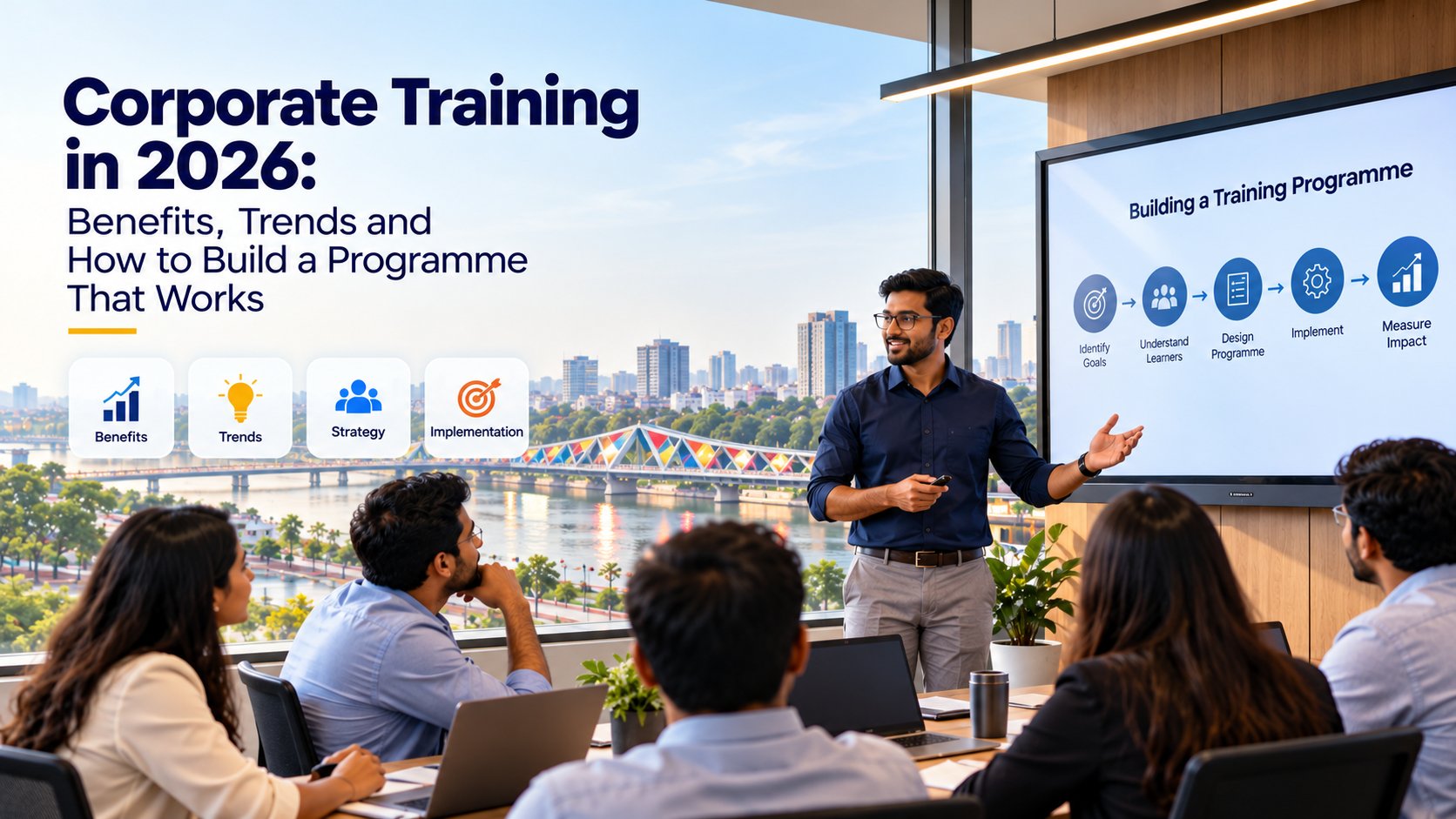
How do you build a corporate training programme?
- Define the business problem. For example: “Reduce onboarding time for support staff from 12 weeks to 8.”
- Run a skills gap analysis. Compare the skills roles need with what employees can demonstrate, using assessments, manager input and performance data.
- Set measurable objectives. Include both learning outcomes and business metrics, such as error rate, sales conversion or time to productivity.
- Choose delivery methods. Match the method to the skill (see the table below).
- Involve managers. Managers decide whether new skills are used or ignored after the course, so brief them before and coach them after.
- Pilot, then scale. Test with one team, collect data, fix problems, then roll out.
- Evaluate and iterate. Review results at set intervals and retire what doesn’t work.
Which delivery method fits which need?
| Method | Best for | Limitations |
|---|---|---|
| Instructor-led (in person or live online) | Complex skills, discussion, practice with feedback | Costly to scale; scheduling |
| Self-paced e-learning | Knowledge, compliance, consistency at scale | Low engagement without reinforcement |
| Microlearning | Refreshers, just-in-time help | Rarely enough for complex skills alone |
| Simulation / VR / AR | High-risk or hands-on tasks | Development and hardware cost |
| Coaching and mentoring | Leadership, behaviour change | Depends on coach quality and time |
| On-the-job practice | Applying skills in context | Needs structure and feedback |
Blended approaches generally suit mixed skill needs, but no single mix suits every organisation.
How do you measure the ROI of corporate training?
Two frameworks are widely used. Kirkpatrick’s model evaluates four levels: participant reaction, changes in knowledge, changes in on-the-job behaviour, and changes in business performance. The Phillips ROI Methodology extends it with a fifth level, financial return on investment.
The Phillips formula is ROI (%) = (net programme benefits ÷ programme costs) × 100. The harder step is attribution: isolating how much of a result came from the training (for example with control groups or trend analysis) and converting it to monetary value.
Illustrative example (invented numbers): a programme costs ₹10 lakh. After isolating the training’s effect, you attribute ₹14 lakh of benefit (fewer errors, less rework). Net benefit is ₹4 lakh, so ROI is 40%.
Full ROI analysis is costly, so reserve levels 4–5 for your largest or most strategic programmes.
How much should a company spend on training?
There is no universal figure. For context, ATD’s US surveys reported direct learning expenditure rising from 2.2% to 2.7% of payroll in 2010, 3.2% in 2011 and 4.3% in 2015. These are older, US-based and self-selected samples, so they are not a target for an Indian SME or any specific company. A better method is to cost the skills gap you identified, decide which gaps are most valuable to close, and fund those first.
What are common corporate training mistakes?
- Training without a defined business outcome.
- Treating a one-off workshop as a solution when the skill needs practice and reinforcement.
- Skipping manager involvement.
- Measuring only attendance or satisfaction.
- Buying AI or VR tools before the data and use case exist.
- Copying benchmarks without checking their source.
How do you choose a corporate training partner?
Ask about:
- Experience in your sector and relevant references.
- Ability to adapt content to your roles and tools.
- Assessment methods and how they link results to your KPIs.
- Technology fit with your existing LMS and data.
- Evidence of outcomes, including how the provider isolates training effects.
- Scalability across locations, languages and team sizes.
What are the limits of the evidence?
Most “training ROI” statistics come from surveys, vendor studies or correlations that can’t prove cause and effect. The WEF figures are projections from employer surveys. The most reliable evidence is your own: pilot results, performance data and control comparisons.
Summary
Corporate training works best when it is tied to a specific business problem, based on measured skills gaps, delivered through methods suited to the skill, reinforced by managers and judged against business results. Treat headline statistics with caution and test ideas in your own context.