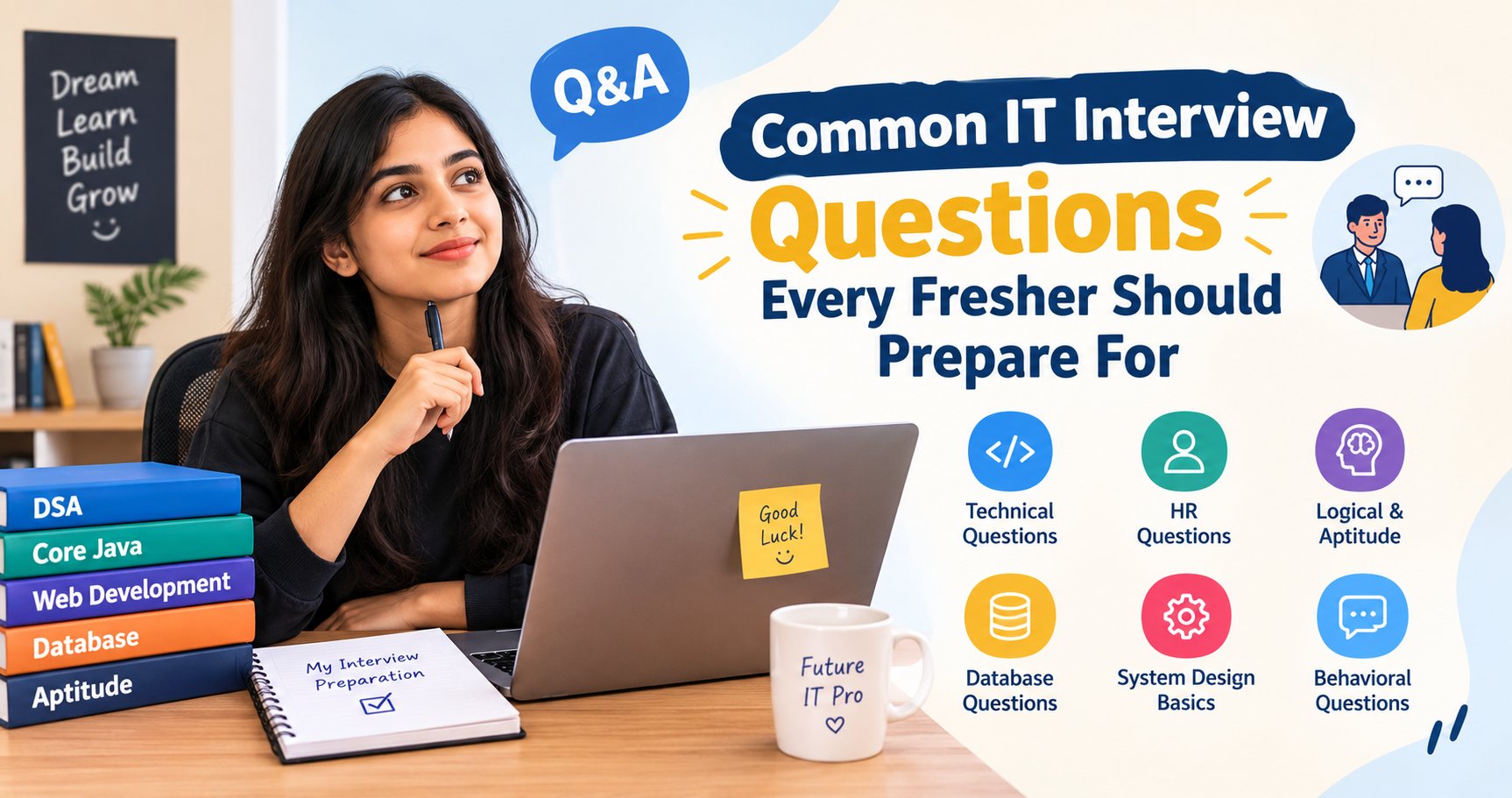
Your first IT interview can feel challenging, especially when you have learned programming, databases, web development, or other technical subjects but are unsure what an interviewer will ask. The good news is that you do not need to know every technology to prepare effectively.
The common IT interview questions for freshers usually cover programming fundamentals, object-oriented programming (OOP), databases, operating systems, networking, basic coding, projects, and communication skills. The exact questions depend on the company and the job role, but a strong understanding of these fundamentals provides a useful starting point.
This guide explains frequently asked questions with simple sample answers, practical examples, and preparation tips for entry-level IT jobs in India.
Why IT Interview Preparation Matters for Freshers
Completing a degree or an IT course gives you foundational knowledge, but an interview tests whether you can explain and apply technical concepts.
For example, you might know that SQL retrieves data from a database. An interviewer may then ask you to write a query, explain the difference between INNER JOIN and LEFT JOIN, or troubleshoot a query returning incorrect results.
Similarly, knowing Python syntax is useful, but an interviewer may ask you to reverse a string, explain a function, or identify an error in your code.
Freshers often face three challenges:
- Conceptual gaps: They memorise definitions without understanding how the concepts work.
- Limited practical experience: They have completed exercises but struggle to explain their own projects.
- Communication difficulties: They know an answer but cannot explain it clearly under pressure.
Preparing across these areas helps you demonstrate your knowledge and problem-solving approach more effectively.
1. General IT Interview Questions for Freshers
These questions assess your understanding of software development and the IT industry.
Q1. What is IT?
Information Technology (IT) involves using computers, software, networks, databases, and digital systems to store, process, secure, and exchange information.
For example, an online shopping application uses IT to manage customer accounts, product information, payments, and order tracking.
Q2. What is the difference between hardware and software?
Hardware refers to the physical components of a computer, such as the processor, RAM, keyboard, and hard drive.
Software refers to the programs and applications that run on those components, such as Windows, Python, Chrome, and Microsoft Excel.
Q3. What is the Software Development Life Cycle (SDLC)?
SDLC is a structured process for developing and maintaining software.
Its common stages are:
- Planning and requirement analysis
- System design
- Development or coding
- Testing
- Deployment
- Maintenance
For example, a team developing a student management system first gathers requirements, designs the database, writes the application, tests its functionality, deploys it, and fixes issues after release.
Q4. What is the difference between frontend and backend development?
Frontend development focuses on the interface users see and interact with. It commonly uses HTML, CSS, and JavaScript.
Backend development manages application logic, server-side processing, authentication, and database communication. Technologies may include Python, Java, Node.js, and PHP.
A full-stack developer works across both areas.
2. Programming Fundamentals Interview Questions
Choose one programming language, such as Python, Java, C++, or JavaScript, and understand its fundamentals well.
Q5. What is a variable?
A variable is a named reference used to store or access a value in a program.
Example in Python:
student_name = "Rahul"
marks = 85

print(student_name)
print(marks)
Here, student_name refers to a string value, while marks refers to an integer value.
Q6. What are data types?
Data types describe the kind of value a variable can represent and the operations supported for that value.
Common Python examples include:
- int: Whole numbers, such as 10
- float: Decimal numbers, such as 10.5
- str: Text, such as "Hello"
- bool: Boolean values, True or False
- list: An ordered, mutable collection
- dict: A collection of key-value pairs
Q7. What is the difference between a compiler and an interpreter?
A compiler translates source code into another form, often machine code or bytecode, before execution or as part of a build process.
An interpreter executes program instructions through an execution environment. Some languages use both compilation and interpretation or virtual-machine execution.
For an interview, avoid saying that every compiler translates an entire program at once or that every interpreter processes only one line at a time. Modern language implementations can work differently.
Q8. What is a function?
A function is a reusable block of code that performs a specific task. It can accept inputs and return a result.
def add(a, b):
    return a + b

result = add(10, 20)
print(result)  # 30
Functions make programs easier to organise, test, and maintain.
Q9. What is the difference between a list and a tuple in Python?
A list is mutable, meaning its elements can be changed after creation. A tuple is immutable, meaning its elements cannot be reassigned through ordinary item assignment after creation.
numbers = [10, 20, 30]
numbers[0] = 100

values = (10, 20, 30)
# values[0] = 100  # Raises TypeError
Use a list when you need to modify a collection and a tuple when you need an immutable sequence.
Q10. What is exception handling?
Exception handling allows a program to respond to errors that occur during execution.
try:
    number = int(input("Enter a number: "))
    print(100 / number)
except ValueError:
    print("Please enter a valid integer.")
except ZeroDivisionError:
    print("The number must not be zero.")
This example handles invalid integer input and division by zero instead of allowing those exceptions to terminate the program unexpectedly.
3. Object-Oriented Programming (OOP) Questions
OOP is particularly important for interviews involving Java, Python, C++, C#, and other object-oriented technologies.
Q11. What is object-oriented programming?
Object-oriented programming organises software around objects that combine data and behaviour.
Its four commonly taught principles are encapsulation, inheritance, polymorphism, and abstraction.
Q12. What is the difference between a class and an object?
A class defines the structure and behaviour of a type. An object is an instance of that class.
class Student:
    def __init__(self, name):
        self.name = name

    def display(self):
        print(self.name)

student = Student("Amit")
student.display()
Here, Student is the class, while student refers to an instance of it.
Q13. What are the four pillars of OOP?
- Encapsulation: Groups data and related methods while controlling access to internal state.
- Inheritance: Allows a class to derive or reuse behaviour from another class.
- Polymorphism: Allows a common interface to support different implementations.
- Abstraction: Hides unnecessary implementation details and exposes essential operations.
Interview tip: Prepare one practical example for each principle instead of memorising definitions alone.
Q14. What is the difference between method overloading and method overriding?
Method overloading generally means providing multiple methods with the same name but different parameter lists, where the language supports it.
Method overriding occurs when a subclass provides its own implementation of an inherited method.
The exact rules differ between languages. For example, Python does not support traditional signature-based method overloading in the same way Java does.
4. DBMS and SQL Interview Questions
Database knowledge is useful for software development, data analytics, testing, and many other IT roles.
Q15. What is a DBMS?
A Database Management System (DBMS) is software used to create, store, retrieve, update, and manage data.
Examples include MySQL, PostgreSQL, Oracle Database, and Microsoft SQL Server.
Q16. What is the difference between SQL and NoSQL databases?
SQL databases commonly organise structured data in tables and use SQL for queries. They are frequently used when relationships and transaction requirements are important.
NoSQL databases use models such as documents, key-value pairs, wide-column stores, or graphs. They can be useful for flexible data structures and particular scalability requirements.
Neither approach is universally better; the choice depends on the application.
Q17. What are primary keys and foreign keys?
A primary key uniquely identifies a row in a table and cannot contain NULL values.
A foreign key establishes a relationship with a candidate or primary key in another table, helping maintain referential integrity.
For example, a department_id in an Employees table may reference a department in a Departments table.
Q18. What is the difference between WHERE and HAVING?
WHERE filters individual rows before grouping. HAVING filters groups after aggregation.
SELECT department, COUNT(*) AS total_employees
FROM employees
WHERE salary > 20000
GROUP BY department
HAVING COUNT(*) >= 3;
This query considers employees earning more than 20,000, groups them by department, and returns departments with at least three qualifying employees.
Q19. What is database normalization?
Normalization organises relational database tables to reduce unnecessary duplication and prevent certain data anomalies.
For example, storing department details repeatedly in every employee record can create inconsistencies when a department's information changes. Separating departments into their own table and referencing them by ID can reduce this duplication.
Q20. What is the difference between INNER JOIN and LEFT JOIN?
An INNER JOIN returns rows with matching records in both tables.
A LEFT JOIN returns every row from the left table and matching rows from the right table. Where no match exists, right-side columns generally contain NULL.
Freshers should practise writing both queries against small sample tables rather than learning only the definitions.
5. Data Structures and Basic Coding Questions
Data structures organise information, while algorithms describe how to process it. Interviewers may ask you to solve a small problem and explain your approach.
Q21. What is the difference between an array and a linked list?
Arrays typically provide efficient index-based access. Linked lists connect nodes through references or pointers and require traversal to access an arbitrary position.
Arrays are often suitable for index-heavy operations, while linked lists can support efficient insertion or deletion when the relevant node and position are already known. The best choice depends on the use case and implementation.
Q22. What is a stack?
A stack follows the Last In, First Out (LIFO) principle. The most recently added element is removed first.
Examples include undo operations, function-call management, and expression evaluation.
Q23. What is a queue?
A queue typically follows the First In, First Out (FIFO) principle. The first element added is the first one removed.
Queues are used in task scheduling, request processing, and breadth-first search.
Q24. Write a program to reverse a string.
Python example:
text = "excelptp"
reversed_text = text[::-1]

print(reversed_text)
Output:
ptplecxe
The slicing expression creates a reversed string. Be prepared to explain how it works and to implement a loop-based solution if requested.
Q25. How do you check whether a number is even or odd?
number = 17

if number % 2 == 0:
    print("Even")
else:
    print("Odd")
The modulo operator (%) returns the remainder. If a number's remainder after division by two is zero, it is even.
Also practise string reversal, palindrome checking, factorial calculation, finding the largest element, counting character frequencies, and basic sorting and searching.
6. Operating System Interview Questions
Q26. What is an operating system?
An operating system (OS) manages computer resources and provides services for applications. Examples include Windows, Linux, and macOS.
Q27. What is the difference between a process and a thread?
A process is an executing program with its own process-level resources and address space under a typical operating system.
A thread is an execution unit within a process. Threads in the same process generally share its address space and many resources.
Q28. What is deadlock?
Deadlock occurs when processes or threads are permanently blocked while waiting for resources held by one another.
The four classic necessary conditions are mutual exclusion, hold and wait, no preemption, and circular wait.
Understanding the definition and a simple example is sufficient to begin preparing this topic for entry-level interviews.
7. Computer Networking and Web Technology Questions
Q29. What is an IP address?
An IP address identifies a network interface or endpoint for communication using the Internet Protocol. IPv4 and IPv6 are the two main versions.
Q30. What is the difference between HTTP and HTTPS?
HTTP is a protocol for transferring web resources. HTTPS uses HTTP over a secure TLS connection, providing encryption and helping authenticate the server.
Q31. What is an API?
An Application Programming Interface (API) defines how software components communicate.
For example, a frontend application may call a backend API to retrieve student details from a database.
Q32. What happens when you enter a URL in a browser?
A simplified explanation is:
- The browser interprets the URL.
- It resolves the server's address, often using DNS.
- It establishes the necessary network connection and, for HTTPS, a secure TLS session.
- It sends an HTTP request.
- The server returns a response.
- The browser processes the response and renders the page.
Actual steps vary depending on caching, connection reuse, protocols, and other factors.
8. Project-Based and Situational Interview Questions
Your resume and projects give interviewers a practical way to assess your knowledge.
Q33. Explain your final-year or personal project.
Structure your answer around five points:
- Problem: The problem you wanted to solve.
- Features: The main features of the application.
- Technologies: The technologies you used and why.
- Contribution: Your individual contribution.
- Challenges: A challenge you faced and how you resolved it.
For example, if you built a student management application, explain how users add records, how the backend validates requests, and how the database stores information.
Q34. What would you do if your application stopped working?
Explain a systematic troubleshooting approach:
- Reproduce the problem.
- Read error messages and application logs.
- Identify the component causing the issue.
- Check recent changes, configuration, dependencies, and network connectivity.
- Apply a focused fix.
- Test the affected functionality and related features.
Avoid claiming you would immediately rewrite the application without first investigating the cause.
Q35. What would you do if you did not know the answer to a technical question?
Be honest. Explain what you do understand, describe how you would investigate the problem, and ask a clarifying question if needed.
Interviewers may value clear reasoning and the ability to learn, even when you cannot immediately recall a definition.
Q36. How do you use AI tools while coding?
Explain how you use AI tools to understand errors, explore possible solutions, generate test cases, or review code. Emphasise that you verify the output, test the solution, and understand the code before using it.
Do not claim that AI-generated code is always correct or secure.
9. HR Interview Questions for IT Freshers
Technical knowledge is only one part of an interview. Practise answering these questions naturally.
Q37. Tell me about yourself.
Give a concise introduction covering your education, relevant technical skills, one project or practical achievement, and the role you want to pursue.
Q38. Why do you want to work in IT?
Connect your interest in technology to something concrete, such as solving problems, developing applications, working with data, or learning new tools.
Q39. What are your strengths and weaknesses?
Choose strengths supported by examples. For a weakness, explain what you are doing to improve rather than offering a generic claim.
Q40. Why should we hire you as a fresher?
Highlight your relevant fundamentals, practical projects, willingness to learn, and ability to accept feedback. Avoid claiming expertise you cannot demonstrate.
Q41. Where do you see yourself in five years?
Describe a realistic direction, such as becoming a dependable developer, data analyst, cloud engineer, or specialist in your chosen field.
Q42. Are you willing to learn new technologies?
Give a genuine example of a technology or tool you learned independently and explain how you applied it.
10. How to Prepare for IT Interviews in 14 Days
Use the following plan as a starting point. Adjust it to your target role and current skill level.
| Days | Preparation focus | Practical activity |
|---|---|---|
| 1–2 | Resume and programming basics | Review every skill listed on your resume |
| 3–4 | OOP and data structures | Explain concepts and solve basic problems |
| 5–6 | DBMS and SQL | Practise SELECT, JOIN, GROUP BY and subqueries |
| 7–8 | Operating systems and networking | Answer fundamentals aloud using examples |
| 9–10 | Coding practice | Solve string, array and number problems |
| 11 | Project preparation | Explain architecture, decisions and challenges |
| 12 | HR questions | Practise your introduction and situational answers |
| 13 | Mock interview | Complete a timed practice round |
| 14 | Revision | Review weak areas and prepare interview documents |
For additional career guidance, explore the ExcelPTP IT Career Blog and its professional IT training programs.
Common Mistakes Freshers Should Avoid
- Memorising answers without understanding the concepts.
- Listing technologies on a resume that you cannot explain.
- Describing a group project without clarifying your own contribution.
- Ignoring SQL, debugging, or basic coding practice.
- Giving unnecessarily complicated answers to simple questions.
- Pretending to know something instead of reasoning honestly.
- Preparing only technical questions and neglecting communication skills.
A better strategy is to practise answering each question in your own words, demonstrate the concept with an example, and prepare for one follow-up question.
Conclusion
Preparing for your first IT interview is easier when you divide the syllabus into manageable topics. Start with programming fundamentals, OOP, databases, networking, and basic coding. Then prepare your projects, practise situational questions, and develop a clear way of explaining your decisions.
You do not need to know every technology to begin applying for entry-level positions. You do need to understand the skills you claim, demonstrate them through practice, and remain honest when you encounter something unfamiliar.
If you need structured practice or guidance on choosing a suitable IT learning path, you can explore ExcelPTP's training programs or contact the team to discuss your goals.