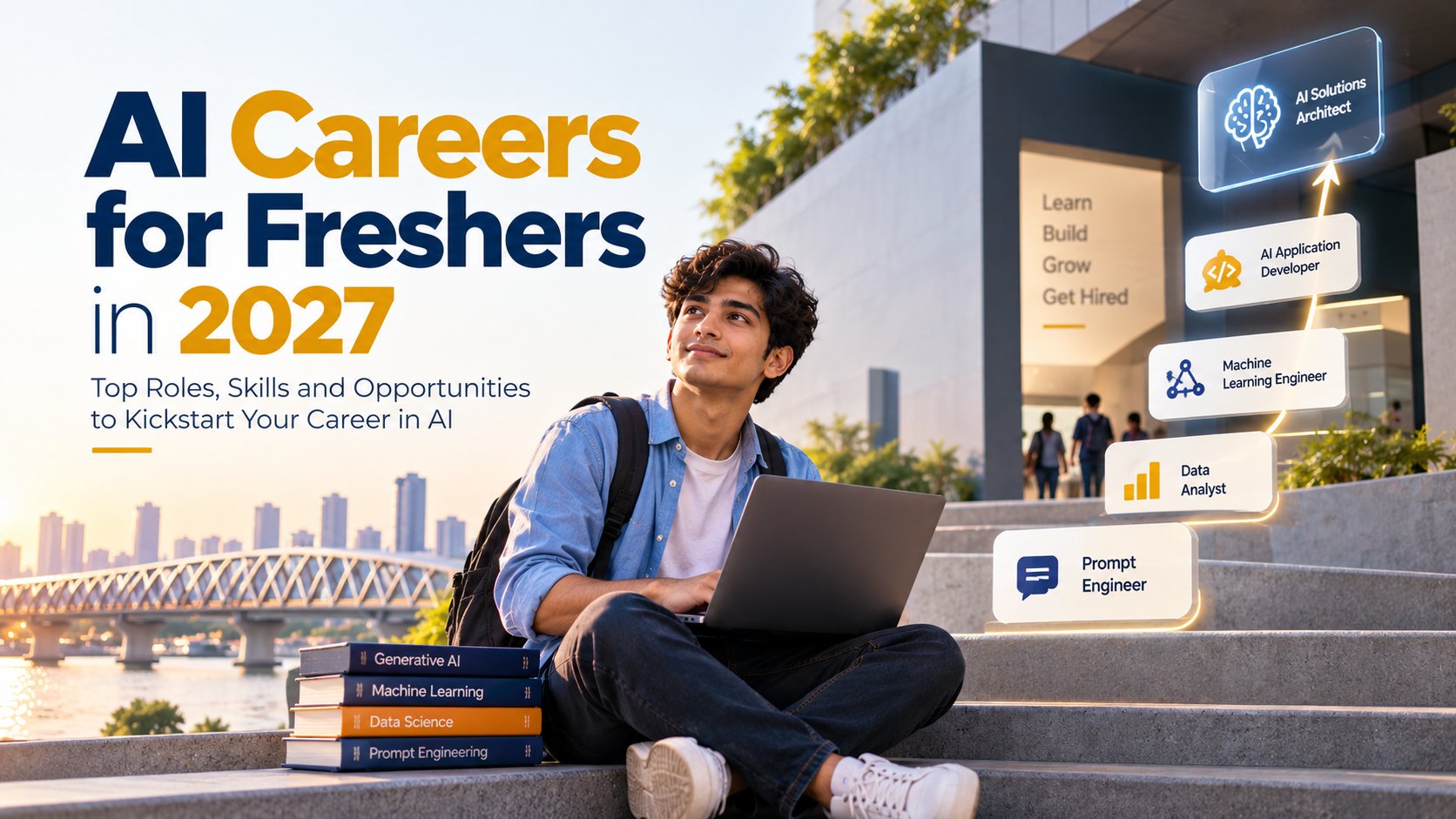
What are AI careers for freshers?
Entry-level AI careers fall into two groups.
- AI-building roles: machine learning engineer, data scientist and MLOps engineer (MLOps means machine learning operations: deploying and maintaining models). These usually need programming, statistics and maths.
- AI-enabled roles: familiar jobs such as software developer, tester, analyst, marketer, business analyst or customer-support specialist, where AI tools are part of daily work. These need a domain skill plus the ability to use AI tools and check their output.
Freshers from non-engineering backgrounds will usually find AI-enabled roles more reachable. Naukri’s campus career guide, for example, describes data annotation and data analyst roles as more accessible entry points than ML engineer or data scientist positions.
What does the hiring data say for 2027?
The table combines monthly figures from Naukri JobSpeak, an index built from job postings and recruiter searches on Naukri.com. It reflects one platform, so read it as a directional signal, not a count of all jobs in India.
Month (2026) | AI/ML roles, year-on-year | Fresher hiring, year-on-year |
|---|---|---|
February | +49% | +17% |
March | +37% | +16% (0–3 years) |
April | +32% | +11% (0–3 years) |
May | +22% | +7% |
June | +25% | +8% |
July | +33% | Not reported in the source consulted |
August | +31% | +15% (0–3 years) |
Naukri defines “fresher” slightly differently from month to month, so compare the direction of travel rather than exact values.
Other evidence adds important context:
- AI/ML growth is consistent. Naukri reported AI/ML hiring up 45% across the 2025–26 financial year.
- Fresher growth is smaller and uneven. In May 2026, fresher hiring growth was driven mainly by hospitality, retail and BPO/ITES (business process outsourcing and IT-enabled services), not by core IT.
- AI/ML demand skews senior. Naukri’s April and May 2026 releases noted demand tilting towards experienced professionals; hiring for the 13–16 years band rose 32% in May.
- Entry-level IT hiring is under pressure. A study by ICRIER (the Indian Council for Research on International Economic Relations), supported by OpenAI, surveyed 651 IT firms between November 2025 and January 2026. 55% reported a decline in entry-level employment and 35% an increase. The researchers noted that the moderation aligns with broader post-pandemic IT trends and cannot be attributed to AI alone.
- Hybrid skills are in demand. In the same study, 63% of firms reported higher demand for candidates with domain expertise plus AI or data skills.
- Forecasts point to a talent gap. A Bain & Company projection reported in March 2025 expected India’s AI job openings to pass 2.3 million by 2027, against a talent pool of about 1.2 million. This is a forecast, not an outcome.
Our reading: AI skills are valued, but entry-level seats are not growing as fast as AI postings overall. Freshers who pair AI-tool skills with a domain skill and visible projects are better placed than those relying on a certificate alone. This is an interpretation, not a finding of any single report.
Which AI roles can freshers apply for in 2027?
Role | What you do | Skills to build | Often suits |
|---|---|---|---|
Junior AI/ML engineer or data scientist | Prepare data, build and test models | Python, statistics, SQL, scikit-learn or PyTorch | Engineering, BCA, BSc (maths, stats, CS) |
Data analyst using AI tools | Clean data, build dashboards, explain findings, speed up analysis with AI | Excel, SQL, Python, BI tools, data storytelling | B.Com, BSc, BCA, engineering |
AI-assisted software developer | Write, debug and review code with AI assistants and verify the output | Python, Java or JavaScript, Git, testing, code review | BCA, MCA, BE/B.Tech |
AI automation developer | Connect AI models to business workflows such as reporting or document handling | Python or low-code tools, APIs, basic cloud | Developers, analysts, IT support |
QA / software tester with AI tools | Use AI to draft test cases and spot defects; check AI output | Manual and automated testing, API testing, SQL | Detail-oriented graduates from any stream |
Digital marketing or content executive with AI | Research, draft and analyse campaigns with AI, then fact-check and edit | SEO, analytics, copywriting, ad platforms | Commerce, arts, management graduates |
Business analyst using AI | Gather requirements, map processes, interpret data with AI support | Requirement writing, SQL basics, process mapping | B.Com, BBA, engineering |
AI customer-support or chatbot specialist | Configure, test and monitor chatbots; improve weak answers | Support know-how, conversational tools, QA habits | Any graduate with strong communication |
A note on prompt engineering. Naukri’s April 2026 summary listed machine learning engineer, search engineer, data scientist and data platform engineer as the most in-demand AI/ML roles, and prompt engineer was not among them. For most freshers, writing clear prompts is better treated as a skill that strengthens a role than as a standalone job title.
How much do entry-level AI jobs pay in India?
Naukri’s campus guide lists indicative fresher ranges of about ₹4–10 lakh per annum (LPA) for AI/ML engineers, ₹8–15 LPA for early-career MLOps engineers, and ₹4–12 LPA at startups and global capability centres (GCCs, the India-based offices of multinational companies). These are broad guides, not offers. Actual pay depends on employer, city, skills and interview performance.
Naukri also reported that hiring of freshers in the ₹20+ LPA band grew 23% year on year in March 2026. Growth rates do not show how many such roles exist, so avoid planning around top-of-band pay. A 2025 Naukri report cited a salary premium of up to 56% for freshers with AI skills; treat it as an older, single-platform figure.
Which skills matter most?
- One core domain skill. Programming, testing, analytics, marketing or business analysis. It gives AI tools something to work on.
- Python and SQL basics. Python is widely used for data work, automation and machine learning, and SQL is a staple of analyst and data roles. The official Python website offers documentation and tutorials.
- Data literacy. Reading, cleaning and questioning data.
- Machine learning basics. Essential if you target AI-building roles: how models learn from data, how they are evaluated and where they fail.
- Using AI tools and checking their output. AI can produce confident mistakes, so verification is a skill an interviewer can test.
- Analytical thinking. The World Economic Forum’s Future of Jobs Report 2025 found analytical thinking the most sought-after core skill (seven in ten employers) and placed AI and big data, networks and cybersecurity, and technological literacy as the three fastest-growing skills to 2030.
- Communication. Explaining what you built, why, and how you checked it.
Do freshers need a computer science degree or coding?
No single answer fits every role. Machine learning engineer and data scientist roles usually expect programming and maths, and a computer science, engineering, statistics or similar background is the common route. Many AI-enabled roles in marketing, business analysis, customer support and testing can be entered from other degrees, though basic data skills still help. Coding is not compulsory for all AI careers, but it is a strong advantage for development, automation and data roles.
How can a fresher start an AI career? Six steps
- Choose a role family. Pick one row from the table above rather than trying to learn all of AI.
- Build the base. Learn Excel or SQL and, for technical roles, Python.
- Learn the AI tools used in that role. Keep a short log of where each tool helped and where it failed. Google’s AI learning resources can complement project work.
- Build two or three projects with a measurable result. Examples are listed below.
- Document each project. State the problem, tools used, how you verified the output, the result and the limits.
- Apply widely and keep learning. Include startups, GCCs and non-IT companies, and adjacent roles such as analyst or tester.
Project ideas (suggestions, not requirements):
- Data analyst: clean a public dataset, build a dashboard, let AI draft a summary, then correct its errors.
- QA: take the user stories of a sample app, have AI draft test cases, run them and record the defects the AI missed.
- Marketing: build an AI-assisted keyword and content brief for a small site, then record what you had to fix.
- Developer: create a small tool that summarises documents through an AI API, with error handling and tests.
- Support: design a FAQ chatbot on a sample knowledge base, test it on 30 questions and report the failures.
Many learners need several months of regular practice to reach a basic portfolio. This is a planning estimate, not a measured figure.
What are the risks and limits?
AI hiring is growing, but the evidence above shows three cautions. Entry-level IT services hiring has softened. Senior AI/ML talent is in the strongest demand. And fresher growth in 2026 has come largely from non-IT sectors. A fresher should therefore keep a fallback plan, such as an adjacent analyst, tester or support role in which AI skills still count. Certificates alone are unlikely to separate candidates; demonstrated work is more persuasive. Figures here come mainly from job-posting platforms and employer surveys, which can differ from actual hiring.
What should freshers in Ahmedabad and Gujarat know?
AI jobs are not limited to the largest metros. Naukri’s July 2025 report said Indore, Coimbatore, Kochi and Ahmedabad together contributed over 1,500 AI jobs between April and June 2025. In 2026, though, the fastest AI/ML growth was reported in cities such as Hyderabad, Delhi NCR, Chennai and Kolkata, and Naukri noted fresher momentum in emerging cities such as Jaipur and Coimbatore. Freshers in Gujarat should be ready for hybrid, remote or relocation options alongside local openings.
How to judge an AI course or training programme
- It includes hands-on practice with the tools your target role uses.
- It requires projects built on realistic problems, not only quizzes.
- Mentors review your work and explain what to fix.
- It teaches you to verify AI output and recognise limitations.
- It links AI to a role such as development, testing, analytics or marketing.
- It publishes honest outcomes instead of guaranteeing jobs.
Summary
Entry-level AI careers in India for 2027 sit in two groups: AI-building roles that need programming and maths, and AI-enabled roles where AI tools support a domain skill. Hiring data through August 2026 shows strong AI/ML growth but a tougher, more selective entry-level market. The best preparation is one core skill, Python and data basics, careful use of AI tools and visible projects.