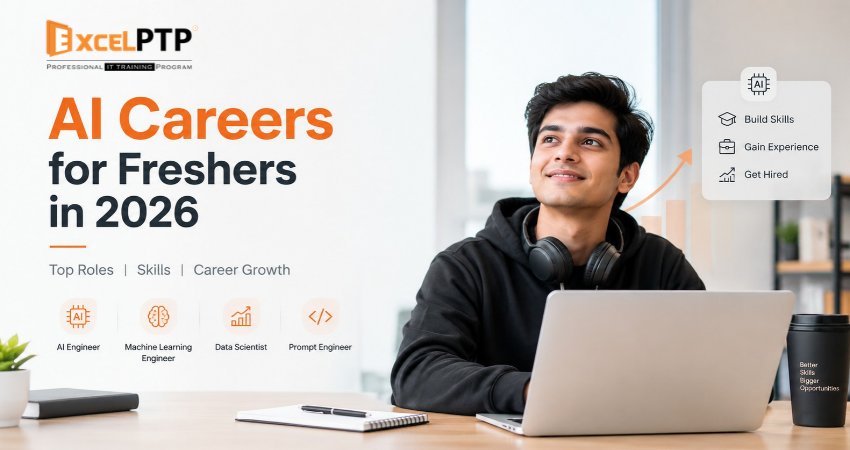
Starting a career in artificial intelligence does not necessarily mean becoming a machine learning researcher or an advanced programmer. Today, AI careers for freshers can include software development, data analysis, digital marketing, software testing, business analysis and AI-powered customer support.
For students and recent graduates in India, the most practical approach is to combine artificial intelligence knowledge with a core professional skill. For example, a graduate who understands data analysis can learn to use AI tools for reporting, while an aspiring developer can use AI-assisted coding tools to support software development.
This guide explores the most relevant AI jobs for freshers, the skills employers may expect, suitable career paths for different educational backgrounds, and practical steps to prepare for an entry-level role.
What Are AI Career Opportunities for Freshers?
AI career opportunities for freshers are entry-level jobs in which employees develop, use, test, maintain or support artificial intelligence technologies. The amount of technical knowledge required depends on the position.
Some roles involve building machine learning models or developing AI applications. Others focus on using existing AI tools to improve business processes, analyse information, generate content or support customers.
Common entry points include:
- AI-assisted software developer
- Junior data analyst using AI tools
- Generative AI application developer
- Software tester using AI-assisted testing tools
- AI-powered digital marketing executive
- Business analyst using AI tools
- Chatbot configuration and support specialist
These roles are not interchangeable. A machine learning engineer typically needs stronger programming, mathematics and model-development knowledge than someone using AI tools for marketing or business reporting.
Freshers should therefore choose a career path according to their existing skills, interests and willingness to learn.
Why Should Freshers Consider a Career in AI?
Artificial intelligence is being integrated into software products and business workflows. Companies can use AI to assist with tasks such as analysing data, generating drafts, supporting software development and responding to customer questions.
For freshers, this creates opportunities to combine familiar professional skills with newer technologies.
The potential benefits include:
- Broader career options: AI-related skills can complement development, testing, marketing, analytics and business operations.
- Practical problem-solving: AI tools can help automate repetitive tasks and support information analysis.
- Opportunities to specialise: Learners can progress from using AI tools to developing applications or working with machine learning.
- Transferable skills: Programming, analytical thinking, communication and data literacy remain useful across many technology roles.
- Portfolio development: Personal projects can demonstrate how a candidate applies AI to a real problem.
However, learning AI does not guarantee employment or a particular salary. Job opportunities depend on employers' requirements, the candidate's abilities, location and experience.
Top 7 AI Careers for Freshers in 2026
1. AI-Assisted Software Developer
An AI-assisted software developer uses AI tools to support coding, debugging, documentation and testing. The developer remains responsible for understanding the code, checking its correctness and ensuring that the application works as intended.
Skills to learn:
- Python, JavaScript or another suitable programming language
- Programming fundamentals and data structures
- Web development or application development
- API integration and debugging
- AI coding assistants and code verification
Who should consider this career?
Students who enjoy programming and solving technical problems may find this path suitable. A portfolio project, such as a simple web application with an AI-powered feature, can help demonstrate practical ability.
2. Generative AI Application Developer
A generative AI application developer builds software that uses AI models to produce or process text, images, summaries and other outputs. Depending on the role, the work may involve connecting applications to AI models through APIs, designing prompts and testing responses.
Skills to learn:
- Python or JavaScript
- API requests and JSON
- Prompt design and output evaluation
- Basic database concepts
- Application security and data privacy
Example project: Build a document summariser that accepts a sample document, produces a summary and allows the user to review the result.
This career generally requires more technical knowledge than simply using AI chat tools. Candidates should understand how applications handle errors, protect sensitive information and manage unreliable outputs.
3. Data Analyst Using AI Tools
A data analyst examines information to identify patterns, answer business questions and prepare reports. AI tools may help with data exploration, formula suggestions, summarisation and visualisation, but the analyst must verify the results.
Skills to learn:
- Excel or Google Sheets
- SQL fundamentals
- Basic statistics
- Data cleaning and visualisation
- Power BI or another relevant reporting tool
- AI-assisted analysis and fact-checking
Example project: Analyse a sample retail sales dataset, identify monthly trends and create a dashboard with recommendations.
This path can suit B.Com, BBA, B.Sc, BCA and engineering graduates, provided they develop the skills required for their chosen role.
4. AI-Powered Digital Marketing Executive
Digital marketing professionals use AI tools to support content research, campaign planning, audience analysis and performance reporting. AI can speed up parts of the workflow, but strategic decisions and quality control still require human judgement.
Skills to learn:
- SEO and keyword research
- Content planning and editing
- Social media marketing
- Analytics and campaign measurement
- AI-assisted research and content workflows
- Fact-checking and brand communication
Example project: Prepare a sample SEO content plan, create an article brief, map relevant keywords and explain how performance would be measured.
This path may be suitable for graduates who enjoy communication, creativity, marketing and analytical work.
5. Software Tester or QA Analyst Using AI Tools
Quality assurance (QA) professionals test software to identify defects and check whether an application behaves as expected. AI-assisted tools can support test-case generation, test automation and analysis of test results.
Skills to learn:
- Software testing fundamentals
- Test cases and bug reporting
- Manual testing techniques
- Basic SQL and API testing
- Automation fundamentals where relevant
- AI-assisted test generation and result validation
Example project: Test a sample registration form, document the expected behaviour, identify defects and prepare a structured test report.
This career can suit detail-oriented freshers who enjoy investigating problems. AI tools can assist with testing, but candidates still need to understand application behaviour and validate test results.
6. Business Analyst Using AI Tools
A business analyst helps organisations understand requirements, document processes and communicate business needs to technical teams. AI can assist with summarising documents, preparing draft requirements and analysing information.
Skills to learn:
- Business communication
- Requirements gathering
- Process mapping
- Excel and basic data analysis
- Documentation and presentation
- Responsible use of AI for research and reporting
Example project: Study a sample online booking process, identify potential user problems and prepare a requirements document describing possible improvements.
This path may suit B.Com, BBA, MBA and other graduates who enjoy analysis, communication and business problem-solving.
7. AI Chatbot and Customer Support Specialist
AI chatbot specialists help configure, test and improve automated customer-support experiences. Depending on the position, responsibilities may include preparing knowledge-base content, testing conversation flows, reviewing unsuccessful responses and escalating complex questions.
Skills to learn:
- Written communication
- Customer service fundamentals
- Conversation and workflow design
- Chatbot configuration
- Prompt design and response testing
- Privacy awareness and escalation procedures
Example project: Create a demonstration FAQ chatbot using publicly available sample information. Test how it handles unclear questions and questions it cannot answer.
Some chatbot support positions require limited coding, while technical chatbot development roles may require programming, API integration and database knowledge.
Which AI Career Is Best for Your Educational Background?
Your degree can help you identify a starting point, but it does not determine every career option available to you.
| Educational background | Potential starting paths | Useful skills to develop |
|---|---|---|
| B.Com or BBA | Data analysis, business analysis, digital marketing | Excel, SQL basics, analytics, communication |
| BCA or B.Sc Computer Science | Software development, QA, data analysis | Programming, databases, testing |
| BE/B.Tech | AI application development, software development, data roles | Programming, mathematics where relevant, APIs |
| BA or other non-IT degree | Digital marketing, chatbot support, business operations | Communication, AI tools, domain knowledge |
| MBA | Business analysis, marketing analytics, AI-supported operations | Data interpretation, reporting, business processes |
These are suggested starting points, not eligibility guarantees. Always compare the actual job description with your skills and qualifications.
Essential Skills for AI Jobs for Freshers
Employers may assess more than familiarity with AI applications. Freshers should be able to explain what they built, how they approached a problem and how they checked the output.
1. AI literacy
Understand what AI tools can do, where they can fail and when their outputs need human review. Learn the basics of generative AI, machine learning and the limitations of automated systems.
2. Programming and technical fundamentals
Python is useful for many AI, automation and data-related roles. JavaScript may be more relevant for web-based AI applications. Choose the language according to the job path rather than trying to learn everything simultaneously.
3. Data literacy
Learn to organise, interpret and validate information. Data-related work requires attention to missing values, incorrect assumptions, misleading visualisations and the quality of the underlying data.
4. Prompt design and evaluation
Learn to give AI tools clear instructions, provide appropriate context and evaluate the responses. Effective prompt design also involves recognising when a response is inaccurate or incomplete.
5. Analytical and problem-solving skills
A useful AI professional understands the problem before choosing a tool. They can compare possible solutions, test assumptions and explain why a particular approach is appropriate.
6. Communication and collaboration
Even technical roles require people to explain decisions, document work and communicate limitations. Clear writing and teamwork can be valuable advantages for freshers.
7. Responsible AI practices
Avoid entering confidential company or customer information into unapproved tools. Check outputs for errors, respect applicable data protection requirements and disclose important limitations when necessary.
How Can Freshers Start an AI Career Step by Step?
A focused learning plan is generally more useful than trying to master every AI technology at once.
Step 1: Choose one career direction
Decide whether you are more interested in programming, data, marketing, software testing, business analysis or chatbot support.
Review several entry-level job descriptions to identify the skills that appear relevant to your preferred role.
Step 2: Build your core skill
Learn the foundations of your chosen field before relying heavily on AI tools. For example, practise SQL for data analysis, software testing fundamentals for QA or programming fundamentals for development.
Step 3: Learn relevant AI tools
Select tools that support your chosen workflow. Practise using them for a defined task and compare the results with a manually checked answer.
Avoid collecting tool names without understanding how or when to use them.
Step 4: Build two or three practical projects
Projects should demonstrate problem-solving rather than merely show that you can operate an AI tool.
Examples include:
- A Python-based task automation script
- A data dashboard with an explanation of the findings
- A tested chatbot with documented limitations
- A sample SEO campaign supported by AI-assisted research
- A software testing report with test cases and bug documentation
Use sample or authorised data, explain your methods and clearly label personal projects as demonstrations rather than professional client work.
Step 5: Document your work
For each project, describe:
- The problem you wanted to solve
- The tools and skills you used
- Your approach and implementation
- How you tested or verified the output
- The limitations and possible improvements
A clear project explanation helps recruiters understand your contribution.
Step 6: Prepare your resume and interviews
Mention relevant skills accurately. Include project links when available and be prepared to explain your decisions, errors and learning process.
Practise foundational questions related to your chosen role rather than memorising AI terminology alone.
Step 7: Apply and keep improving
Apply for internships, trainee roles and suitable entry-level positions. Review feedback, strengthen weak areas and update your projects as your skills develop.
A Practical 12-Week AI Learning Roadmap for Beginners
The following is a suggested study plan, not a promise that every learner will be job-ready within 12 weeks. Progress depends on your starting knowledge, study time and target role.
| Period | Learning focus | Practical outcome |
|---|---|---|
| Weeks 1–2 | AI fundamentals and career selection | Identify one target role and its skill requirements |
| Weeks 3–4 | Core skills for the selected role | Complete basic exercises in programming, data, marketing or testing |
| Weeks 5–6 | Relevant AI tools and responsible usage | Complete guided exercises and verify results |
| Weeks 7–9 | Project development | Build one or two role-specific projects |
| Weeks 10–11 | Portfolio, resume and interview preparation | Document projects and practise explaining them |
| Week 12 | Applications and skills review | Apply to suitable opportunities and identify knowledge gaps |
For a technical AI engineering role, additional study in mathematics, machine learning, data structures and model evaluation may be necessary.
How to Choose an AI Training Programme
A training programme should help you build demonstrable skills, not just familiarise you with AI terminology.
Before enrolling, consider the following:
- Practical curriculum: Does the syllabus match the role you want to pursue?
- Hands-on projects: Will you build and test working projects?
- Mentor feedback: Can someone review your work and help you correct mistakes?
- Core fundamentals: Does the programme teach the underlying skills required by the target job?
- Responsible AI: Does it address verification, privacy and limitations?
- Career preparation: Does it include resume guidance, project presentation or interview practice where appropriate?
- Transparent terms: Are course fees, duration, prerequisites and placement-related terms clearly explained?
Compare the syllabus and teaching approach with current entry-level job requirements. A certificate may document training, but it does not independently establish job readiness.
How ExcelPTP Can Help You Explore AI Training
Students in Ahmedabad and across Gujarat can explore structured IT training to strengthen their technical foundations and practical skills.
ExcelPTP lists training options related to AI and emerging technologies, artificial intelligence and machine learning, and generative AI. Review the individual course syllabus, prerequisites, duration and learning format before choosing a programme.
Explore these resources:
- AI & Emerging Technologies Training
- Artificial Intelligence and Machine Learning Course
- Generative AI Training Course
Choose a course that aligns with your preferred career path and provides opportunities to practise, receive feedback and explain your project work. Confirm current course details directly with ExcelPTP before making an enrolment decision.
Common Mistakes Freshers Should Avoid When Learning AI
Learning tools without developing fundamentals
AI tools can help complete tasks, but you need enough subject knowledge to recognise errors and judge the quality of the result.
Trying to learn every AI technology
Machine learning, generative AI, automation and AI-assisted marketing involve different skills. Choose a starting direction and expand gradually.
Depending entirely on AI-generated work
Submitting code, reports or assignments without checking them can lead to mistakes. Test the output and understand how it was produced.
Building projects without explaining the problem
A project is more useful when you can explain the need it addresses, the decisions you made and how you tested the outcome.
Believing that one certificate guarantees a job
Employers may evaluate skills, projects, communication and role-specific knowledge. Training should be one part of a broader preparation plan.
Ignoring privacy and responsible use
Use authorised data and review the privacy policies of the tools you use. Never assume that an AI-generated answer is automatically accurate or safe to share.
Conclusion: Build Your AI Career Around Practical Skills
AI careers for freshers span multiple fields, from software development and data analysis to digital marketing, testing and business operations. The right starting point depends on your educational background, interests and existing strengths.
Begin by selecting one target role, learning its core skills and practising with relevant AI tools. Build projects that demonstrate your problem-solving ability, verify your results and document your work clearly.
If you need structured guidance, compare relevant training programmes and their practical components before enrolling. Consistent learning, project experience and a realistic understanding of your chosen field can help you prepare for suitable entry-level opportunities.
Frequently Asked Questions
1. Is AI a good career option for freshers in 2026?
AI can be a useful career direction for freshers who enjoy technology, analysis, development or business problem-solving. Opportunities vary by role and employer. Combining AI knowledge with a relevant core skill and practical projects is a more useful preparation strategy than relying on AI tool familiarity alone.
2. Do freshers need a computer science degree to start an AI career?
No. Some AI engineering roles require strong technical and mathematical foundations, but not every AI-related job has the same requirements. Graduates from commerce, business and arts backgrounds can explore suitable roles in areas such as marketing, business analysis and customer support by developing the relevant skills.
3. What are the best AI jobs for freshers without coding?
Potential options include AI-assisted digital marketing, business operations, chatbot support and some content-related roles. The amount of coding varies by employer. Candidates should still learn how to evaluate AI outputs, protect information and apply the fundamentals of their chosen profession.
4. Which programming language should a beginner learn for AI?
Python is a practical starting point for many AI, automation, data analysis and machine learning tasks. JavaScript can be useful for web-based AI applications. The best choice depends on your target role, so review relevant job descriptions before deciding which language to learn first.
5. Can B.Com students build a career in AI?
Yes. B.Com graduates can explore paths such as data analysis, AI-supported digital marketing and business analysis. Learning Excel, data interpretation, SQL basics or relevant marketing tools can provide a foundation. The next step is to build practical projects that connect AI with a real business task.
6. What skills are required for AI jobs for freshers?
The requirements depend on the role, but useful skills can include AI literacy, analytical thinking, communication, output verification and responsible data handling. Technical roles may also require Python, SQL, programming, mathematics or machine learning fundamentals. Focus on the skills that match your chosen career path.
7. How long does it take to prepare for an entry-level AI role?
There is no fixed timeline. A beginner learning AI tool usage for an existing professional skill may follow a different path from someone preparing to develop machine learning models. A structured 12-week plan can provide a starting framework, but technical depth, project quality and job requirements may require additional study.
8. Are AI certifications enough to get a job as a fresher?
A certificate can show that you completed a learning programme, but it does not prove every skill an employer needs. Practical projects, technical understanding, communication and the ability to explain your work can strengthen an application. Choose training that includes meaningful practice and feedback.
9. How can freshers build an AI portfolio without professional experience?
Start with personal projects using sample or authorised data. Examples include a data dashboard, a chatbot demonstration, a simple AI-powered application or a software testing report. Document the problem, tools, process, verification and limitations. Clearly identify these as personal projects rather than paid client work.
10. Where can students in Ahmedabad learn AI skills?
Students can compare training programmes offered by local institutes and online learning providers. ExcelPTP publishes information about AI and emerging technologies, artificial intelligence and machine learning, and generative AI training. Check the current syllabus, prerequisites, teaching format, practical work and fees before enrolling.